Case Study · 2026 Est. Read — 6 Min

How Eyewear AI Studio cut 7-day edits to minutes at 90% less cost.

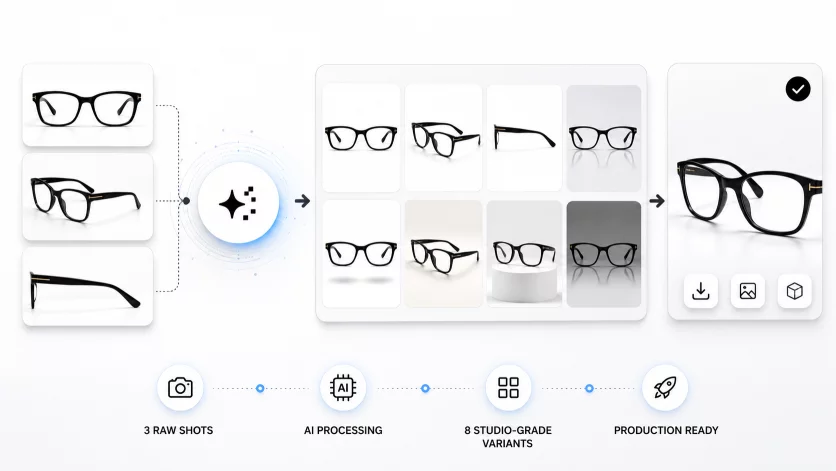
We replaced a week-long human editing workflow with an automated AI pipeline turning three raw shots of an eyewear frame into eight studio-grade, ERP-ready variants in under an hour.

Computer Vision Generative AI Backend E-commerce
Fig. 01 — Pipeline Console / Batch View Production · v2.1
Pipeline Console / Batch View
Client
Optifashion
Industry
Eyewear
Engagement
Build + Handoff
Services
AI · Backend · Frontend
Deployment
Dockerized · AWS
Results at a glance

A week of editing, compressed into minutes.

1000x
Faster turnaround
90%
Reduction in cost
8×
Variants per upload
01/06 Context

A week per frame wasn't viable anymore.

The client's e-commerce pipeline ran on a manual editing queue raw studio photography in, eight format-perfect assets out, with humans doing every step in between.

Problem

A manual queue that couldn't keep up with the catalog.

Three raw shots per frame (front, diagonal, side) were handed off to human editors who corrected angles, balanced lighting and shadows, removed backgrounds, and standardized aspect ratios producing a white-background JPG and a transparent PNG for every variant. Lead time for a single frame regularly stretched to a full week.

~7d
Per-frame lead time
Variants per frame
Goal

Studio-quality output at a fraction of the cost.

Build an automated, AI-driven pipeline that matches the visual quality of expert manual editing correct lighting, clean mattes, accurate half-glass crops at a fraction of the cost and turnaround time, while elevating the consistency of the catalog overall.

Hours
Target turnaround
100%
Format coverage
02/06 What we built

Six surfaces, one pipeline.

Each capability was designed to be operable by the catalog team not just the ML org. Together they take a raw shot to an ERP-ready asset without a manual touch.

F.01

Automated studio-quality processing

Gemini-driven enhancement normalizes lighting, contrast, white balance and aspect ratio across batches matching the look of the in-house studio standard.

Component
F.02

High-fidelity background matting

An advanced rembg model (isnet-general-use) extracts pixel-accurate transparent masks without nicking thin temples, hinges, or reflective lens edges.

Component
F.03

Multi-format asset generation

Every upload fans out into JPG, PNG, and WebP across transparent, white-background, and half-glass variants up to eight ERP-ready files per source image.

Component
F.04

Algorithmic half-glass extraction

Custom vertical-projection bridging logic detects the eyewear's bridge and crops a precise half-glass variant for angled shots automating a previously eyeballed manual task.

Component
F.05

Distributed processing queues

Celery workers backed by Redis handle AI inference, compositing, and S3 transfers in parallel, with the Gemini Batch API used for non-urgent jobs at 50% cost.

Component
F.06

Secure role-based access

JWT-authenticated frontend with strict RBAC ensures only authorized catalog operators can upload, queue, or download generated assets.

Component
03/06 Stack

Boring infrastructure, modern AI.

We picked components the client's engineering team could own after handoff proven web stack, contained model surface, observable workers.

Backend 01
FastAPIHTTP layer
SQLAlchemyORM
PostgreSQLState
Python-JOSEJWT
Frontend 02
React + ViteApp
Tailwind CSSStyling
ZustandState
TanStack QueryData
AI / Imaging 03
Gemini APIEnhancement
rembg · isnet-genMatting
Pillow (PIL)Compositing
Gemini BatchBulk jobs
Infra 04
Celery + RedisQueue
AWS S3Storage
Docker ComposeRuntime
NginxProxy
04/06 Hard problems

Where the pipeline earned its keep.

Three places the textbook approach broke and what we shipped instead.

CH / 01

Matching manual editor quality with AI.

Quality Multi-stage AI
Challenge

The bar wasn't just "automated" it was "indistinguishable from an expert editor." That meant nuanced lighting correction, clean lens reflections, and precise edge detection on delicate temples, all without a human in the loop and at a fraction of the cost and turnaround.

Solution

We assembled a multi-stage processing pipeline: Gemini AI handles lighting, shadow, and aspect-ratio normalization first, then an advanced rembg model (isnet-general-use) extracts a transparent mask without damaging thin frame elements. The two stages compound neither alone matched the standard; together they did.

+
CH / 02

Algorithmic half-glass extraction.

Computer Vision Custom geometry
Challenge

The catalog required a "half-glass" crop variant of angled shots a view editors previously produced by eyeballing the bridge of the frame and cropping freehand. There was no off-the-shelf model for it, and frame geometry varies wildly across SKUs.

Solution

We wrote custom bridging logic using vertical projection over the alpha mask finding the bridge column algorithmically and cropping a precise half-glass view. A subjective manual task became a deterministic, repeatable function.

+
CH / 03

Asynchronous high-volume throughput.

Architecture Scale
Challenge

Catalog drops meant hundreds of high-resolution RAW images arriving at once. Synchronous handling would have blocked the API, starved the workers, and stalled S3 uploads and the client couldn't accept a queue that fell over under peak load.

Solution

We split the HTTP layer from background processing. FastAPI accepts and records jobs instantly; Celery workers on Redis handle AI inference, Pillow compositing, and S3 transfers in parallel. Non-urgent jobs route through the Gemini Batch API at 50% cost same quality, longer SLO.

+
05/06 Architecture

The pipeline, end-to-end.

Five stages from RAW upload to ERP-ready asset.

System Diagram Runtime 01 / 05
Stage 01

Authenticated upload + filename parsing.

Catalog operators authenticate via JWT with strict RBAC, then upload batches of RAW images through a React + Vite frontend. The backend parses the strict filename convention ({PRODUCT_CODE}_{VIEW_NUMBER}.ext) and auto-detects view type 1=Front, 2=Angle, 3=Side.

Client
React + Vite React Query Zustand
Auth
JWT RBAC policy
Parse
Filename schema View detect (1 / 2 / 3)
06/06 Outcomes

What changed for the catalog team.

Numbers measured against the pre-rollout manual workflow. The system replaced a tedious editor queue with a seamless AI engine that matches human quality at a fraction of the cost.

KPI / 01
1000×
Faster week to minutes, per frame

What used to take a full week of manual editor handoffs now completes in minutes; automated end-to-end, with no editor in the loop.

KPI / 02
8×
Variants per upload

JPG / PNG / WebP × transparent / white-BG / half-glass generated dynamically per source image.

KPI / 03
90%
Cost reduction vs. manual editing

AI processing costs a fraction of manual output with further savings on non-urgent jobs via the Gemini Batch API.

KPI / 04
Pro
Grade Output vs. manual

Catalog QA accepts AI output at parity with the previous human-editor baseline.

KPI / 05
60d
Automated S3 retention

Lifecycle policy expires assets; a Celery Beat job cleans the DB rows in lockstep.

Client
OF
eCommerce Operations Lead
Optifashion
The pipeline matches what our editors used to ship and it does it before the next batch even lands.

Have a manual pipeline that should be a model?

A consultancy for applied AI