
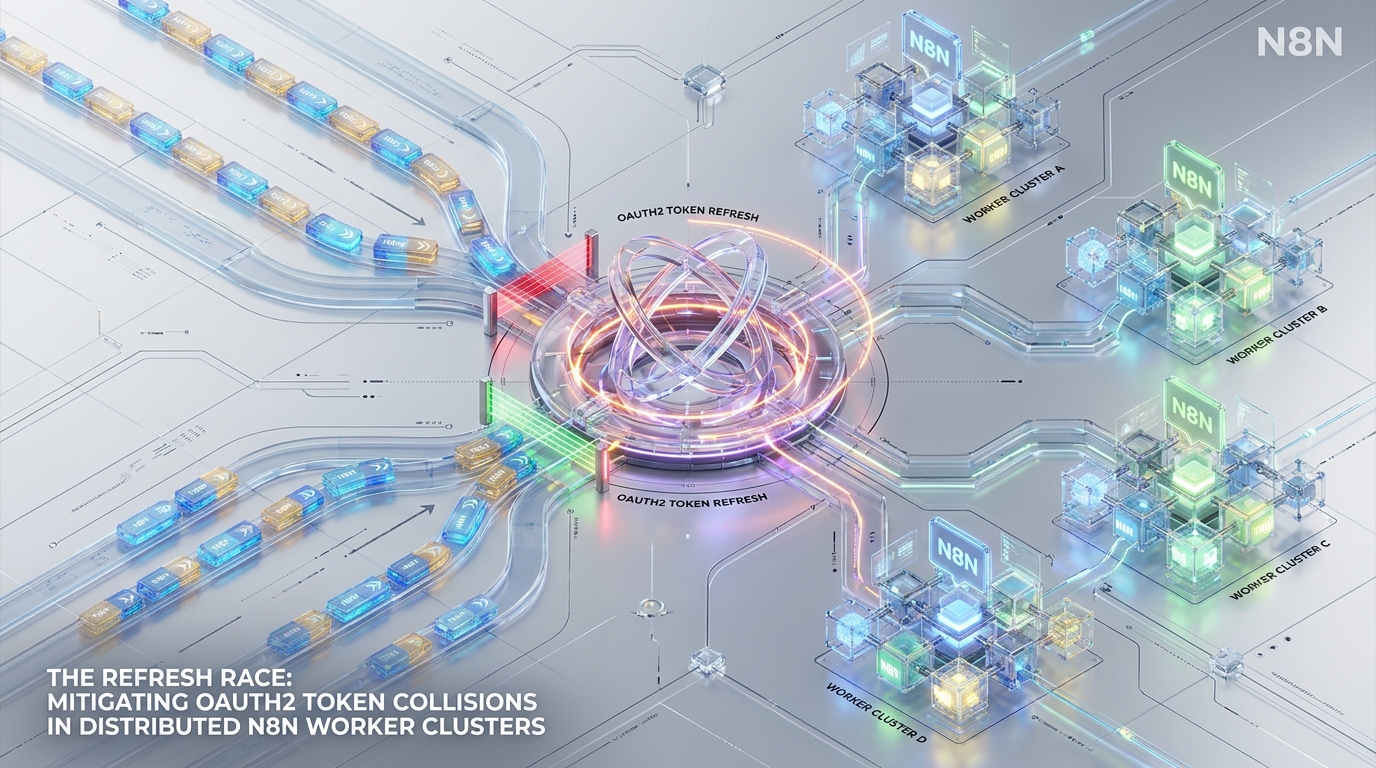
In highly available n8n deployments utilizing Queue Mode, execution is heavily decentralized to maximize throughput. The Main Node operates strictly as an orchestration plane, rapidly delegating execution payloads to an array of isolated Worker Nodes via Redis-backed BullMQ. To eliminate latency bottlenecks and prevent the Main Node from becoming a single point of failure, credential handling intentionally bypasses it at execution time. Instead, distributed Worker Nodes interact directly with the PostgreSQL shared state store.
This event-driven architecture unlocks significant horizontal scaling. When a burst of incoming webhooks occurs, BullMQ seamlessly dispatches parallel execution jobs to all available workers. Each worker independently queries the PostgreSQL credentials_entity table, retrieves the serialized credential payload, and performs in-memory symmetrical decryption using the cluster-wide N8N_ENCRYPTION_KEY via AES-256-GCM.
From a throughput perspective, this design is elegantly efficient. However, this same decentralized speed introduces a severe distributed state synchronization flaw when interfacing with strict modern Identity Providers (IdPs) that enforce rigorous security protocols.
Concurrent Expiration State and OIDC Revocation
The architectural fracture occurs at the intersection of parallel execution and OAuth2 Refresh Token Rotation (RTR).
Within the Node.js worker environment, the system evaluates the decrypted OAuth2 payload by comparing oauthTokenData.expiresIn against Date.now(). If the access token is expired, the worker initiates the OAuth2 refresh sequence. The hard limit of this design is not just database connection pool saturation though a default poolSize: 50 will rapidly bottleneck during high-burst scheduling but the absolute absence of native distributed state synchronization during the decryption-to-refresh window.
When NN workers evaluate an expired credential simultaneously for example, a burst of 20 webhooks triggering parallel executions a catastrophic race condition occurs within a critical 20-50ms window.
- Concurrent Hydration: Workers AA, BB, and CC independently decrypt the credential, calculate that it has expired, and concurrently fire HTTP POST requests to the IdP’s
/tokenendpoint. Critically, they are presenting the exact same Refresh Token. - Refresh Token Rotation (RTR): Strict IdPs, including Salesforce, Google Workspace, and Microsoft Entra ID, enforce RTR in alignment with OIDC security best practices. A refresh token is intended to be single-use.
- The Race Collision: Worker AA‘s network request reaches the IdP first. The IdP processes the request, issues a new Access Token and a new Refresh Token, and permanently invalidates the old Refresh Token. Approximately 15ms later, Worker BB‘s request arrives, presenting the now-invalidated Refresh Token.
- Catastrophic Revocation: Under strict OIDC threat models defined by RFC 6819, presenting an invalidated refresh token is the primary indicator of a replay attack or token compromise. The IdP’s security matrix takes immediate defensive action: Reuse Detection. It revokes the entirety of the grant chain. All access tokens and refresh tokens associated with that user session are permanently destroyed.
- The Impact: The entire n8n cluster permanently loses API access. All subsequent jobs in the BullMQ queue fail with
invalid_grantor401 Unauthorizederrors. The automation pipeline halts completely until a human operator intervenes to manually execute a new interactive OAuth2 consent flow via the n8n UI.
Engineering Distributed Atomicity
The n8n core maintainers have attempted to serialize credential refreshes at the database level (most notably in PR #33092). However, relying on PostgreSQL row-level locks under high worker contention fundamentally misaligns with the demands of highly concurrent event-driven architectures. It introduces severe deadlocks, latency spikes, and exhausts the poolSize: 50 limit as workers block waiting for I/O operations to resolve over external networks.
To achieve enterprise-grade guarantees and prevent grant revocation, Platform Architects must bypass native database locks and implement one of the following advanced architectural patterns.
Advanced Mitigation Strategies
Strategy A: Redis-Backed Distributed Mutexes (Redlock)
To guarantee cluster-wide atomicity strictly during token hydration, we must implement a distributed locking mechanism. Because Redis is already deployed within the n8n stack to support BullMQ, it is the optimal infrastructure for a distributed mutex via the Redlock algorithm.
If you are modifying the n8n core or maintaining a custom enterprise fork, the updateOauth2Credential function must be wrapped in a Redlock pattern using ioredis or the redlock library. This ensures that only one worker can negotiate with the IdP at any given millisecond.
// Theoretical Engineering Model: Distributed Mutex for Token Refresh
const Redlock = require('redlock');
const redlock = new Redlock([redisClient], {
  driftFactor: 0.01,
  retryCount: 10,
  retryDelay: 200, // 200ms backoff
  retryJitter: 50
});

const resource = `n8n:lock:credential:${credentialId}`;
const ttl = 5000; // 5 second hard limit for IdP response

try {
  const lock = await redlock.acquire([resource], ttl);

  // 1. Re-fetch from DB to check if another worker ALREADY refreshed it while we waited
  const latestCred = await db.fetch(credentialId);
  if (!isExpired(latestCred)) {
    await lock.release();
    return latestCred.accessToken;
  }

  // 2. Perform HTTP POST to IdP
  const newTokens = await performOAuthRefresh(latestCred.refreshToken);

  // 3. Write to Postgres
  await db.update(credentialId, newTokens);

  await lock.release();
  return newTokens.accessToken;
} catch (error) {
  throw new Error("Lock acquisition failed, backing off to prevent IdP revocation.");
}
Architectural Rationale: This strategy mathematically prevents the race condition. When Worker AA acquires the lock, Workers BB and CC enter a retry loop with a 200ms delay and a 50ms jitter. By the time BB and CC acquire the lock, they perform a secondary state hydration (db.fetch). They recognize the token has already been refreshed by AA, bypass the IdP network call, and proceed with execution. The risk of RFC 6819 Reuse Detection is reduced to zero.
Strategy B: Singleton Queue Routing for Auth-Volatile Nodes
If modifying the underlying TypeScript codebase of n8n is impossible due to operational constraints, the race condition must be isolated via architectural topology. This involves routing all workflows that interact with strict IdPs to a dedicated singleton worker.
By pinning specific executions to a constrained queue, we manipulate the dispatcher to serialize the network requests organically.
- Tagging: Apply a specific execution tag (e.g.,
strict-oauth) to workflows interfacing with strict environments like Salesforce or Google Workspace. - Worker Isolation: Deploy a dedicated n8n worker container configured to listen only to this specific queue.
- Concurrency Constraint: Force a strict concurrency limit of 1 on this specific worker, preventing parallel job execution at the compute level.
# docker-compose.yml snippet for the Singleton Worker
n8n-worker-singleton:
  image: n8nio/n8n:latest
  command: worker --concurrency=1
  environment:
    - EXECUTIONS_PROCESS=main
    - QUEUE_BULL_REDIS_HOST=redis
    - N8N_WORKER_CONCURRENCY=1
  deploy:
    resources:
      limits:
        cpus: '0.5'
        memory: 512M
Architectural Rationale: This approach introduces a deliberate compute bottleneck. Throughput for these specific API calls is severely reduced because jobs are processed sequentially. However, it absolutely eliminates the parallel execution race condition without requiring custom code forks. It guarantees sequential token hydration, ensuring the IdP’s RTR mechanism is never triggered concurrently.
Strategy C: Bypassing Native n8n Credential Managers (External Vaults)
For maximum scalability where high-throughput parallel execution is non-negotiable, Platform Architects must decouple OAuth2 state management from n8n entirely. Native n8n credential management is ultimately bound by PostgreSQL row-locking and Node.js event-loop constraints.
To bypass this, deploy an external Token Hydrator or Secret Vault (such as HashiCorp Vault with OIDC plugins, or a purpose-built FastAPI/Redis CacheHandler sidecar cluster).
- Decoupling: The external service is singularly responsible for handling the Refresh Token Rotation against the IdP. It exposes a high-performance, internal endpoint for Access Token retrieval.
- Native Abandonment: Inside n8n, developers must abandon the use of native
OAuth2credential types for these specific nodes. - Dynamic Injection: Inject the Access Token dynamically at runtime using a preceding HTTP Request node or a Custom Auth Header evaluated via n8n expressions.
// Example: Dynamic Token Injection in n8n Workflow
[
  {
    "name": "Fetch Access Token from Internal Vault",
    "type": "n8n-nodes-base.httpRequest",
    "parameters": {
      "url": "http://internal-token-vault.svc.cluster.local/api/v1/tokens/salesforce",
      "method": "GET",
      "authentication": "none"
    }
  },
  {
    "name": "Salesforce API Call",
    "type": "n8n-nodes-base.httpRequest",
    "parameters": {
      "url": "https://your-domain.my.salesforce.com/services/data/v58.0/sobjects/Account",
      "sendHeaders": true,
      "headerParameters": {
        "parameters": [
          {
            "name": "Authorization",
            "value": "=Bearer {{ $json.accessToken }}"
          }
        ]
      }
    }
  }
]
Architectural Rationale: While this requires provisioning and maintaining external infrastructure, it permanently solves database-level locking limitations in n8n. The sidecar or Vault handles concurrency internally (often using high-performance Go or Rust state managers), allowing infinite horizontal scaling of n8n workers. Workers no longer query the credentials_entity table for volatile OAuth state, entirely mitigating the risk of IdP grant revocation.
Before vs After: Architectural Performance Benchmarks
To quantify the impact of these mitigation strategies against the native, failing n8n cluster configuration, we evaluate the system under a simulated load of 50 concurrent webhooks triggering identical OAuth2 nodes during a token expiration window.
| Architecture Topology | Concurrency Limit | Peak Throughput (Jobs/sec) | DB Pool Saturation (poolSize: 50) | IdP Revocation Probability | Implementation Overhead |
|---|---|---|---|---|---|
| Native n8n (Failing) | Unbounded | High (Until Failure) | Critical (Deadlocks) | 100% (within 20-50ms) | None |
| Strategy A: Redlock Mutex | Unbounded | Medium-High | Low (Managed via Redis) | 0% | High (Requires core fork) |
| Strategy B: Singleton Queue | Strict 1 | Low (Deliberate Bottleneck) | Low | 0% | Low (Topology change only) |
| Strategy C: External Vault | Unbounded | Maximum (Vault dependent) | Zero (Bypasses Postgres) | 0% | High (Requires external infra) |
Performance Audit and Specialized Engineering
Resolving highly specific distributed race conditions requires more than basic infrastructure provisioning; it demands rigorous architectural alignment. At Azguards Technolabs, we specialize in Performance Audits and Specialized Engineering for complex integration platforms.
When enterprise teams scale n8n beyond basic single-instance deployments into distributed Kubernetes clusters, native edge cases surrounding state management, database saturation, and memory limits immediately become mission-critical bottlenecks. We engineer custom mitigations from HashiCorp Vault integrations and high-performance Rust sidecars, to deep codebase forks optimizing Redis mutexes ensuring your workflows process millions of payloads deterministically without triggering IdP security matrices.
We do not just deploy infrastructure; we harden the logic running on top of it.
The “Refresh Race” is a fundamental architectural limitation of coupling fast, horizontal compute with slow, database-backed credential state. When execution is highly concurrent, the 20-50ms window required to evaluate, request, and persist an OIDC Refresh Token Rotation is ample time for multiple isolated workers to trigger a catastrophic Reuse Detection event on strict IdPs.
Azguards Technolabs
Ready to Architect Scalable Integrations?
Don't let token collisions and database deadlocks compromise your distributed n8n cluster. Our team of specialized engineers can audit your architecture and implement custom mitigations to ensure robust, enterprise-grade reliability.
Get in Touch