
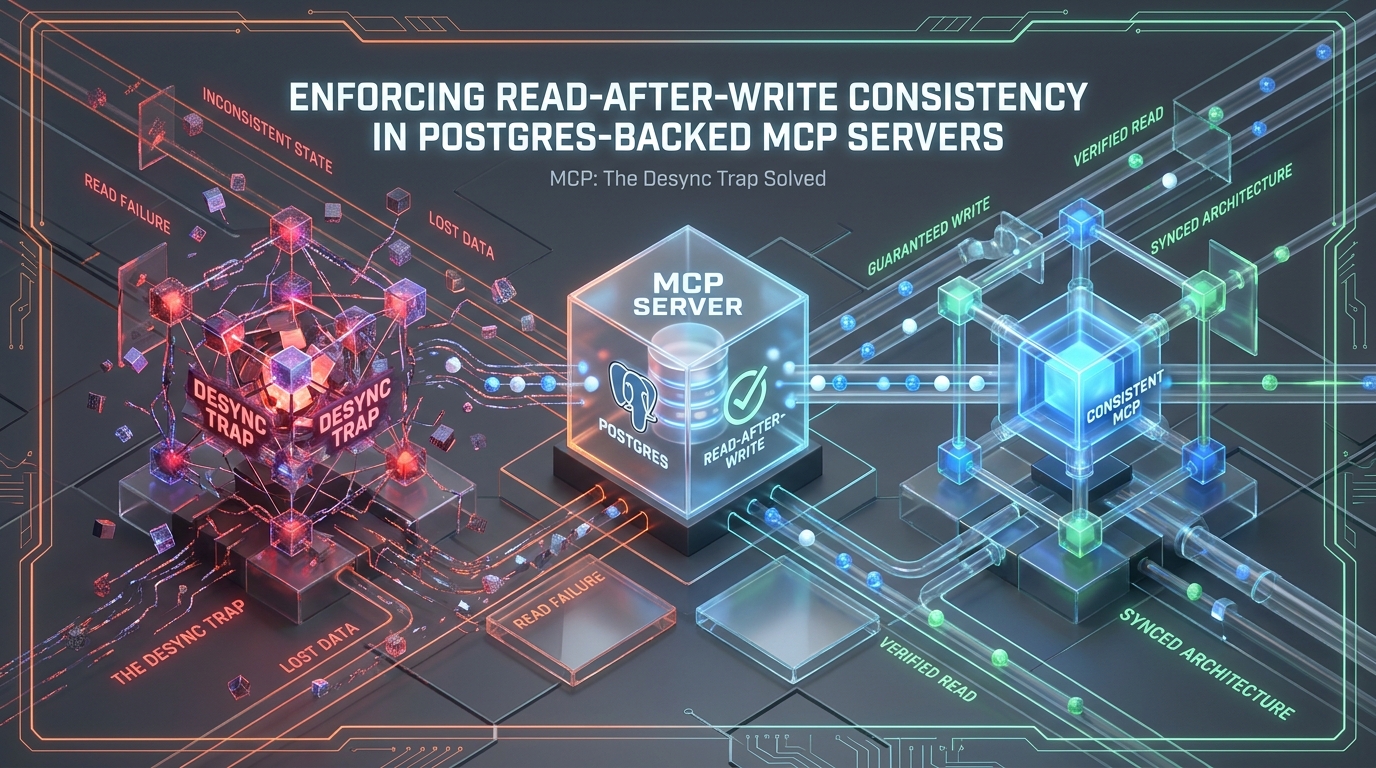
In high-throughput agentic workflows built on the Model Context Protocol (MCP), the sub-second reasoning loops of modern Large Language Models (LLMs) have fundamentally outpaced standard relational database synchronization. With ultra-fast inference engines like Groq LPU or localized vLLM instances, turnaround times now frequently drop below 50ms.
This blistering speed creates a severe data layer conflict. When an MCP client executes a write (tools/call) immediately followed by a read (resources/read) against a Postgres-backed server, it triggers Read-After-Write (RAW) consistency anomalies. The LLM processes the read request faster than the Postgres Write-Ahead Log (WAL) can replicate across the cluster, feeding stale MVCC snapshots directly back into the agent’s context window and causing catastrophic state hallucinations.
Moving beyond default connection pooling is no longer optional. Mitigating the “Desync Trap” demands strict architectural interventions: explicit transaction boundary passing via zero-copy deserialization routing, enforcing the RETURNING mutation pattern to bypass read replicas entirely, and guaranteeing deterministic ordering via session-level Postgres advisory locks.
The RAW Desync Mechanism in MCP Execution Lifecycles
In standard client-server models, Read-After-Write consistency is easily maintained via session affinity. In stateless, highly concurrent MCP architectures, this affinity is immediately severed by two primary vectors: PgBouncer state loss and asynchronous commit windows.
PgBouncer Transaction Mode State Loss
To support the connection volume required by parallel agent execution, MCP servers invariably deploy PgBouncer (or equivalent JVM-based pools like HikariCP) utilizing pool_mode = transaction. Under this configuration, backend database connections are returned to the pool immediately upon the issuance of a COMMIT.
When the LLM follows a write with a resources/read call, the pool assigns a dynamically available backend. In distributed architectures utilizing connection string routing (e.g., target_session_attrs=read-only), this subsequent read is frequently routed to a standby node. Given the <50ms LLM reasoning latency, this read operation queries the replica before the primary’s WAL has been applied. Because typical replication lag under load hovers between 10ms and 100ms, the read hits the replica in a stale state.
Asynchronous Commit Windows
To drive tool execution latency as low as possible, many teams configure Postgres with synchronous_commit set to off, local, or remote_write. While this optimizes the immediate write speed, it guarantees a race condition in agentic workflows.
Under asynchronous commits, the MCP server returns a 200 OK / JSON-RPC success payload to the LLM before the WAL is flushed to disk or confirmed by standby replicas. The LLM’s immediate follow-up read queries the MVCC snapshot before the transaction’s XID (Transaction ID) is universally visible. The database correctly serves the snapshot according to its isolation rules, but from the perspective of the LLM’s cognitive architecture, the tuple is missing or stale.
Agentic Failure Modes: Hallucination Cascades & Infinite Retries
LLM cognitive architectures—whether built on ReAct, Plan-and-Solve, or custom directed acyclic graphs—operate on strict monotonic state assumptions. The agent assumes that if a tools/call succeeds, the resulting state mutation is permanently and immediately queryable. A stale read in the reasoning loop violates this assumption, triggering catastrophic operational failures.
The Infinite Retry Loop
When a state mutation is not reflected in the subsequent read, agents lacking explicit loop-breaking logic will fallback to a retry mechanism, effectively creating an infinite loop that burns compute and token limits.
- Write: The agent emits a
tools/call->INSERT INTO documents...(e.g., executing a local script via Javy for Wasm-sandboxed processing). - Success: The MCP server responds with HTTP 200 / JSON-RPC success.
- Read: The agent emits
resources/read->SELECT * FROM documents...to verify insertion or fetch auto-generated primary keys. - Stale Snapshot: The read replica serves a stale MVCC snapshot; the record is missing.
- Divergence: The agent perceives the write as failed, hallucinates a logical error in its previous payload, and re-emits the exact
tools/call.
State Hallucination Cascades
A more insidious failure mode occurs when a tool modifies a system state (e.g., updating a processing flag from pending to active). If a stale read feeds the pending state back into the LLM context window, the agent ingests false reality. It then executes downstream branch logic designed specifically for the pending state. The system’s actual database state and the agent’s internal state tracking permanently diverge, resulting in corrupted workflow outputs and hallucinated actions.
Hard Limits and System Thresholds
Architecting a mitigation strategy requires operating within the rigid boundaries of Postgres connection management and shared memory limits. Attempting to brute-force session affinity without respecting these thresholds will crash the data tier.
PgBouncer Client Limitations: The max_client_conn threshold (default 100) is rapidly exhausted if MCP servers hold long-lived connections open simply to ensure RAW consistency across sequential agent steps.
Advisory Lock OOM Threshold: Postgres advisory locks are tracked in a shared memory hash table. The hard ceiling is bounded by the formula max_locks_per_transaction * max_connections. Using standard defaults, this yields a maximum of 64 * 100 = 6400 lock objects. Exceeding this threshold in high-concurrency MCP environments instantly triggers an ERROR: out of shared memory fatal exception.
WAL Apply Delay: The max_standby_streaming_delay is configured to a default of 30s. If analytical queries or heavy reads conflict on replicas, the apply lag can artificially inflate to the maximum delay threshold, dramatically worsening the RAW desync window and invalidating standard cache invalidation TTLs.
Senior-Level Architectural Mitigations
To stabilize MCP architectures backed by distributed Postgres clusters, we must bypass the standard read-replica lag entirely or enforce strict deterministic routing at the middleware layer.
1. Explicit Transaction Boundary Passing via MCP Meta Headers
Because standard MCP JSON-RPC payload specifications lack built-in session affinity, we must inject routing directives at the protocol level. By injecting a correlation ID into the _meta property of the JSON-RPC envelope, the MCP server can implement a localized, high-speed connection router.
To avoid garbage collection pauses and parsing latency, this router should be backed by Redis and utilize memory-mapped routing via libraries like rkyv for zero-copy deserialization. When a write occurs, the MCP server tags the agent’s session ID in Redis with a TTL strictly matching the P99 replication lag (e.g., 200ms). Any subsequent reads matching this session ID within the TTL window are forcefully routed to the primary node.
# MCP Server Primary-Routing Middleware
async def handle_mcp_request(request: JSONRPCRequest):
# Extract correlation ID injected by the agent client
agent_session = request.params.get("_meta", {}).get("session_id")

if request.method == "tools/call":
# Execute write on the Primary node
await db.primary.execute(request.params)

# Set RAW affinity lock in Redis for 500ms (P99 replication lag buffer)
# Utilization of zero-copy deserialization ensures minimal overhead
await redis.setex(f"raw_affinity:{agent_session}", 0.5, "primary")
return Success()

elif request.method == "resources/read":
# Check affinity TTL
affinity = await redis.get(f"raw_affinity:{agent_session}")

# Route to primary if affinity exists, otherwise distribute to replica
target_db = db.primary if affinity == b"primary" else db.replica
return await target_db.fetch(request.params)
The RETURNING Mutation Pattern (Eliminating the Read)
The most resilient and lowest-latency solution to distributed consistency is avoiding the distributed RAW race condition entirely. By enforcing strict architectural use of the Postgres RETURNING clause within the MCP tool execution itself, the mutated state is returned directly inside the tools/call response payload.
This pattern natively updates the LLM context window with the exact database truth, negating the requirement for a subsequent resources/read call and eliminating replica round-trips. Furthermore, wrapping this in Optimistic Concurrency Control (via system column xmin) prevents parallel agents from overwriting contiguous states.
-- Enforced Tool Execution Query Pattern
WITH updated_state AS (
UPDATE agent_workspace
SET status = 'processing', metadata = '{"step": 2}'::jsonb
WHERE workspace_id = $1
AND xmin = $2 -- Opt-in Optimistic Concurrency Control
RETURNING id, status, metadata, xmin::text AS new_version
)
SELECT json_build_object(
'status', 'success',
'resource_state', (SELECT row_to_json(updated_state.*) FROM updated_state)
);
Deterministic Ordering via Postgres Advisory Locks
When agent workflows involve complex multi-tool operations that span multiple logical transactions where RETURNING is structurally insufficient, we must enforce deterministic reasoning queues using session-level advisory locks.
Because standard transaction locks are automatically released when PgBouncer (pool_mode = transaction) returns the connection to the pool, developers must utilize explicit transaction blocks (BEGIN ... COMMIT) intrinsically tied to the agent session. By hashing the MCP session_id into a 64-bit integer, we leverage pg_try_advisory_xact_lock() to ensure single-threaded mutation per agent workspace, failing fast if collision occurs.
-- MCP Server-Side SQL Wrapper for Write Tools
BEGIN ISOLATION LEVEL REPEATABLE READ;

-- Acquire transaction-level advisory lock based on agent session hash
-- Fails fast if another thread/agent is modifying the workspace
SELECT pg_advisory_xact_lock(hashtextextended('agent-session-123', 0));

-- Execute LLM Tool Logic
INSERT INTO reasoning_graph (node_id, state) VALUES ($1, $2);

COMMIT;
Recommended Postgres/PgBouncer Configurations
Application-layer mitigations will fail if the underlying database and pooling configurations actively work against them. To support the architectural patterns detailed above, strict configuration enforcement is required at the infrastructure level.
PgBouncer Segregation and Cleanup
We must segregate connection pools to establish dedicated lanes for Writes (Tools) and Reads (Resources). Furthermore, aggressive cleanup prevents prepared statement leakage across transaction boundaries—a critical vulnerability when dealing with diverse LLM payload structures.
# pgbouncer.ini
[databases]
# Segregate pools: Primary for Tools (Writes), Replica for Resources (Reads)
# Use routing logic in MCP server to override when RAW affinity is active
primary_db = host=primary port=5432 pool_mode=transaction max_db_connections=200
replica_db = host=replica port=5432 pool_mode=transaction max_db_connections=500

[pgbouncer]
# Crucial: Prevent prepared statement leakage across transaction boundaries
server_reset_query = DISCARD ALL
# Aggressive cleanup for agentic bursts to prevent connection exhaustion
server_idle_timeout = 60
Postgres Consistency and Apply Tuning
At the database layer, we must balance write durability against read availability. On the primary, we enforce disk-level consistency before acknowledging tool success to the MCP client. On the replica, we strictly limit the streaming delay to prevent agent reads from pausing during heavy WAL application.
# postgresql.conf (Primary Node)
# Trade-off: Guarantee disk-level consistency before MCP acknowledges tool success
synchronous_commit = on

# postgresql.conf (Replica Node)
# Prevent the replica from pausing agent reads during heavy WAL apply
max_standby_streaming_delay = 5s
max_standby_archive_delay = 5s
Performance Benchmarks & System Impact
Implementing these mitigations results in a structural shift in MCP execution reliability. By addressing the hardware constraints and protocol-level mismatches, systems transition from non-deterministic, retry-heavy execution loops into monotonic, highly consistent agentic workflows.
Below is the benchmark analysis detailing the shift in system performance metrics before and after implementing the required architectural patterns.
| Metric / Threshold | Unmitigated MCP Implementation | Mitigated Architecture |
|---|---|---|
| LLM RAW Turnaround Window | <50ms | Eliminated via RETURNING pattern |
| Replication Lag Impact | 10ms - 100ms (Stale Reads) | Bypassed via 200ms - 500ms TTL Affinity Routing |
| State Hallucination Rate | High (Divergent branch execution) | Near Zero (Monotonic state guarantees) |
| PgBouncer Exhaustion | Rapid hit on 100 max_client_conn limit |
Sustained load via segmented 200/500 connection pools |
| Advisory Lock Saturation | OOM crashes at 6400 lock limit | Controlled via fast-fail hashtextextended hashing |
| WAL Apply Delay Impact | Bloats to 30s default under contention | Capped firmly at 5s max_standby_streaming_delay |
| Compute Token Waste | Severe (Infinite retry loops) | Minimal (Deterministic success/failure states) |
Architecting the Future
The transition from stateless REST APIs to stateful, highly concurrent MCP architectures exposes the deepest fault lines in legacy relational database configurations. The “Desync Trap” is not a minor edge case; it is a fundamental architectural bottleneck that degrades agent reasoning, burns inference compute, and corrupts production data states.
Resolving these distributed systems challenges requires more than tweaking timeouts. It demands deep, specialized engineering—from zero-copy serialization implementations to granular Postgres shared memory optimization.
At Azguards Technolabs, we specialize in solving the hard parts of engineering. We partner with elite engineering teams to execute comprehensive Performance Audits and Specialized Engineering overhauls for high-stakes AI infrastructure. We do not deal in generic advice; we build resilient, high-throughput data tiers designed specifically for the cognitive architectures of tomorrow.
If your LLM agents are caught in infinite retry loops, or if your Postgres cluster is buckling under the concurrency demands of your MCP servers, your architecture requires a foundational review. Contact Azguards Technolabs today to schedule an architectural audit and harden your agentic infrastructure against distributed failure.
Would you like to share this article?
Azguards Technolabs
Hardening Your AI Infrastructure
If your LLM agents are caught in retry loops or your database is buckling under high concurrency, your architecture requires a foundational review. Let our specialized engineering team eliminate your distributed system bottlenecks.
Schedule an Architectural Audit