
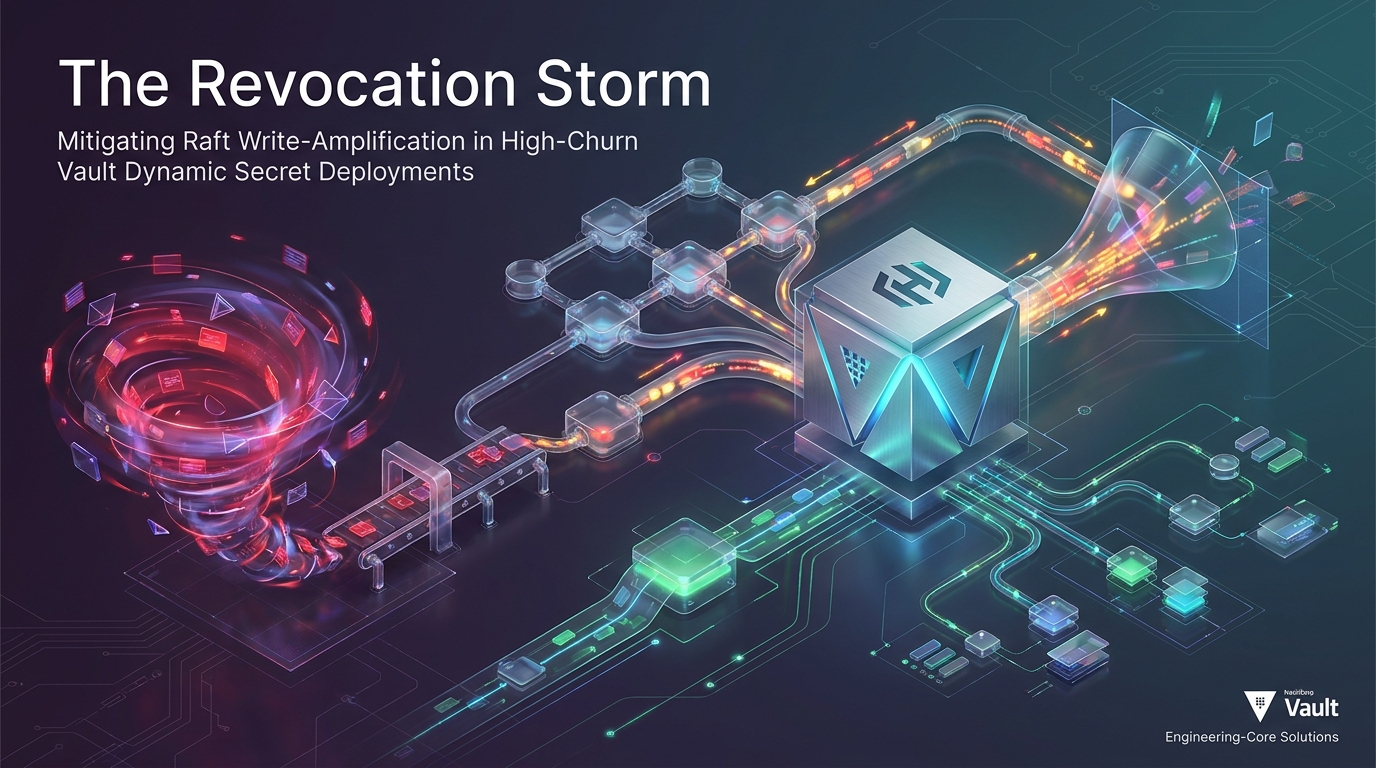
In modern enterprise environments, adopting HashiCorp Vault for dynamic secrets management fundamentally elevates security posture. However, a critical architectural reality is often overlooked: in Vault’s Integrated Storage (Raft) backend, dynamic secrets are not simply generated strings—they are distributed state modifications. Whether your applications request ephemeral PostgreSQL credentials or short-lived AWS STS tokens, every single generation mandates a durable write to the consensus log.
As infrastructure patterns accelerate toward high-churn workloads—such as aggressive CI/CD deployment pipelines, auto-scaling serverless functions, and dynamic Kubernetes orchestration—platform architectures demand an unprecedented volume of credentials with aggressive Time-To-Live (TTL) parameters. This paradigm shift transforms Vault from a simple secrets manager into a high-throughput state machine, requiring meticulous architectural tuning to prevent catastrophic failure at scale.
The Revocation Storm
When Vault is treated as a stateless credential API rather than a CP (Consistency/Partition Tolerance) state machine, engineering teams often encounter an architectural edge case known as the “revocation storm” or “lease explosion.”
A revocation storm occurs when high-churn workloads with short TTLs induce extreme write-amplification on the underlying Raft log. The lease creation queues and lease expiration queues eventually overlap, overwhelming the Active Node’s storage layer and compute threads. The resulting I/O saturation triggers cascading consensus failures, transitioning a localized performance bottleneck into a total cluster outage.
Modulating State Machine I/O
To survive lease explosions, Principal Platform Architects must move beyond horizontal scaling and focus on state machine limits. Mitigating Raft write-amplification requires compartmentalizing the blast radius via namespace lease quotas, detuning Raft consensus sensitivity, mitigating snapshot thrashing at the BoltDB layer, and isolating the Active Node via strictly routed Performance Standbys.
This deep-dive dissects the mechanics of the revocation storm and outlines the precise architectural tuning required to stabilize Vault in high-churn environments.
State Machine Lifecycle & The Write Amplification Multiplier
To understand the operational failure mode, we must examine the lifecycle of a dynamic secret through Vault’s Raft storage layer. A single credential generation involves multiple distributed state transitions.
- Creation and Replication: When a client requests a dynamic secret, Vault generates the credential and writes its associated lease metadata to the Raft log. Because Vault requires strong consistency, this write must be replicated to a quorum of nodes. On each node, the storage engine (BoltDB) issues an
fdatasyncsyscall to flush the write directly to disk, ensuring durability before acknowledging the client. - In-Memory Tracking: Once durable, the Active Node’s lease manager tracks the TTL of the credential entirely in memory.
- Expiration and State Deletion: Upon TTL expiry, the Active Node’s expiration manager initiates a revocation. This requires an external API call to the target system (e.g., executing a
DROP USERcommand in PostgreSQL). Crucially, this event mandates a secondary state mutation to delete the lease from Vault’s Raft state machine, requiring another replicated consensus sequence and anotherfdatasyncto disk.
The Multiplier Effect: In a high-churn environment, an application cluster might request thousands of leases per second. Because these requests are delayed by their TTL duration, they eventually manifest as a secondary, overlapping wave of revocation writes.
If the revocation queue outpaces the Active Node’s ability to append and replicate deletion operations, the system experiences exponential write amplification. The Active Node suffers severe out-of-memory (OOM) pressure tracking the backlog, while the underlying storage layer faces total I/O saturation processing the concurrent fdatasync calls.
Storage Layer Exhaustion and Consensus Degradation
HashiCorp Vault’s Integrated Storage relies heavily on low-latency disk I/O and precise network heartbeats to maintain cluster consensus. When a revocation storm exhausts the storage layer, the failure domain rapidly escalates from slow secret generation to total cluster unavailability.
The degradation sequence follows a predictable path:
1. Latency Spikes in vault.raft.put
BoltDB enforces synchronous disk writes for data integrity. As the combined IOPS of incoming lease generations and expiring lease revocations breach the provisioned hardware limits (e.g., maxing out the IOPS ceiling or queue depths of an AWS gp3 volume), disk wait times skyrocket. Telemetry for the vault.raft.put operation will spike from a healthy baseline of 1–100ms to deeply critical multi-second delays (>500ms).
2. Blocked Threads and Missed Heartbeats
The Vault Active Node utilizes the same CPU execution context and I/O threads to process Raft log appends and to broadcast consensus leader heartbeats to follower nodes. When thread pools are blocked waiting on an exhausted disk queue, the Active Node silently fails to transmit its timely AppendEntries RPCs.
3. Cascading Leader Flapping
The cluster’s follower nodes operate on strict election timeout windows. Failing to receive AppendEntries heartbeats, the followers assume the leader has crashed. They immediately transition to the candidate state, increment the Raft term, and force a new election.
During an election, all cluster read and write processing is halted. Because the new leader will inevitably inherit the exact same massive revocation queue and identical IOPS constraints, it will also exhaust its disk and fail to send heartbeats. This creates a continuous, cascading denial of service known as “leader flapping.”
Theoretical Engineering Model: The I/O Exhaustion Benchmark
To illustrate the arithmetic of a revocation storm, we can model a production workload generating 5,000 dynamic AWS IAM credentials per second with a strict 60-second TTL.
At T=0, the storage layer easily handles the 5,000 fdatasync operations. However, at T+60s, the first batch of leases expires precisely as new leases continue to arrive.
Incoming Writes: 5,000 creations/sec
Revocation Writes: 5,000 deletions/sec
Total Storage Load: 10,000 IOPS Standard SSD provisioning is typically not designed to sustain 10,000 continuous fdatasync IOPS, rapidly approaching enterprise SAN limits. If the backing storage volume enforces a hard limit of 8,000 IOPS, the remaining 2,000 operations per second are forced into the wait queue.
Within exactly 5 minutes of sustained overlap, the system will backlog 600,000 operations. The following table models the timeline of consensus failure:
| T-Minus | Incoming Writes/sec | Revocation Writes/sec | IOPS Demand | Storage Deficit | Queued Operations | vault.raft.put Latency |
Raft Cluster State |
|---|---|---|---|---|---|---|---|
| T+0s | 5,000 | 0 | 5,000 | 0 | 0 | 12ms | Healthy (Active) |
| T+30s | 5,000 | 0 | 5,000 | 0 | 0 | 15ms | Healthy (Active) |
| T+60s | 5,000 | 5,000 | 10,000 | -2,000 | 2,000 | 120ms | Degraded (Wait queues forming) |
| T+120s | 5,000 | 5,000 | 10,000 | -2,000 | 120,000 | 850ms | Critical (Missed heartbeats) |
| T+360s | 5,000 | 5,000 | 10,000 | -2,000 | 600,000 | >3,000ms | Offline (Leader Flapping) |
Advanced Mitigation & Architectural Tuning
Surviving high-churn, ephemeral credential deployments requires defensive engineering. Rather than simply throwing vertically scaled disks at the problem, architects must implement localized rate-limiting and tune Vault’s consensus thresholds to tolerate extreme I/O pressure.
1. Compartmentalizing Blast Radius (Lease Count Quotas)
The single most effective defense against lease explosions is hard-limiting the state machine size at the namespace level. You cannot allow a rogue application or misconfigured CI pipeline to treat your Vault cluster as an infinitely scaling datastore.
Vault allows administrators to enforce a max_leases quota via the /sys/quotas/lease-count API. By determining the maximum acceptable state size for a specific workload, you force Vault to fail closed at the edge. If an application requests leases in a loop and hits the threshold, Vault blocks authentication and secret generation with a 429 Too Many Requests status. This prevents operations from ever entering the state machine, saving the revocation queue from future exhaustion.
# Define a namespace-scoped quota for a high-churn workload
curl --header "X-Vault-Token: $VAULT_TOKEN" \
--request POST \
--data '{
"path": "ci-cd-namespace",
"max_leases": 25000,
"inheritable": true
}' \
$VAULT_ADDR/v1/sys/quotas/lease-count/cicd-quota
2. Modulating Consensus Sensitivity (performance_multiplier)
If your Vault cluster runs on infrastructure prone to high-latency I/O—such as stretched clusters across availability zones, or virtual machines backed by shared SANs—Raft’s default failure detection mechanisms are too aggressive for high-churn operations.
The performance_multiplier (often referred to conceptually as the raft_multiplier tuning parameter) governs the sensitivity of leader election timeouts. The default value is 5. Each increment of this integer translates to approximately 1–2 seconds of delay in election timeouts.
By increasing this value, you explicitly relax the heartbeat requirements. This grants the Active Node the necessary breathing room to survive transient disk I/O freezes caused by revocation spikes without immediately triggering false-positive leader flapping.
# vault.hcl
storage "raft" {
path = "/opt/vault/data"
node_id = "raft_node_1"

# Relax consensus timing to tolerate I/O contention (Max: 10)
performance_multiplier = 7
}
3. Throttling Snapshot Thrashing (snapshot_threshold)
Raft manages its log size via snapshotting (compaction). By default, Vault takes a Raft snapshot every 8192 commits to truncate the log. During a revocation storm, 8,192 commits are easily generated in a matter of seconds.
This triggers an operational hazard known as “snapshot thrashing.” The Active Node continuously allocates massive amounts of memory to serialize the current state machine and dumps the entire snapshot to disk. This continuous filesystem operation severely exacerbates the very disk I/O bottleneck that triggered the instability.
Increasing the snapshot_threshold trades disk space for a reduction in IOPS. The local raft.db file will grow larger between snapshots, but the continuous I/O penalty of writing full memory dumps to disk is drastically minimized. Accompanying this with a higher trailing_logs value ensures follower nodes can catch up on missing replication data without requiring the Active Node to transfer a massive, gigabyte-sized full snapshot over the network.
# vault.hcl
storage "raft" {
path = "/opt/vault/data"
node_id = "raft_node_1"

# Increase threshold to reduce snapshot frequency under heavy load
snapshot_threshold = 32768

# Retain enough logs to allow followers to catch up without requiring a full snapshot transfer
trailing_logs = 15000
}
4. Read Isolation via Performance Standbys
In Vault Enterprise deployments, high-frequency read operations (e.g., Transit engine encryption requests, KV datastore reads) utilize the exact same HTTP handlers, memory spaces, and CPU threads as Raft consensus operations. During a revocation storm, innocent read queries compete directly with the expiration manager for compute cycles.
Platform Architects must strictly isolate the read path by utilizing Performance Standby Nodes. By configuring an L4/L7 load balancer (such as HAProxy) to route all non-state-changing traffic to follower nodes, you effectively fan out the read workload. Standby nodes service these reads securely from their local replication cache.
This architectural pattern completely isolates the Active Node, reserving 100% of its CPU threads and Disk IOPS strictly for processing the Raft log, maintaining consensus heartbeats, and managing the critical lease expiration queue.
# HA Proxy / Load Balancer pseudo-logic for Performance Standbys
acl is_write_req method POST PUT DELETE
acl is_sys_req path_beg /v1/sys/

# Route state modifications directly to the Active Node
use_backend vault_active if is_write_req or is_sys_req

# Fan-out high-volume read workloads to Performance Standbys
default_backend vault_perf_standbys
Performance Audit & Specialized Engineering
Identifying the IOPS ceiling of your Raft backend before an AWS STS lease explosion takes down your production deployment is the difference between robust infrastructure and catastrophic failure.
At Azguards Technolabs, we specialize in the “Hard Parts” of platform engineering. We do not treat enterprise security tools as black boxes; we engineer them at the syscall and state machine level. Our Performance Audit and Specialized Engineering practices help enterprise teams model theoretical IOPS limits, conduct precise chaos engineering against storage engines, and architect HashiCorp Vault deployments that remain fiercely resilient under extreme load.
Whether you require advanced traffic routing algorithms for Performance Standbys, or a complete overhaul of your application lease structures and TTL configurations, Azguards partners with your DevSecOps leads to validate and harden your most critical systems.
The transition toward ephemeral credentials significantly improves your organization’s security posture, but it shifts the engineering burden directly onto the state machine’s storage layer. A revocation storm is not a bug; it is the predictable consequence of a high-churn workload colliding with asynchronous deletion queues and synchronous disk I/O constraints.
Relying on hardware over-provisioning will eventually fail. True architectural resilience demands explicit state limits via lease quotas, precise detuning of Raft consensus parameters, optimization of snapshot thresholds to prevent disk thrashing, and rigorous HTTP request routing to isolate the Active Node.
Do not wait for a lease explosion to force a cluster rebuild under incident conditions. Contact Azguards Technolabs today for an advanced architectural review, and ensure your distributed secrets infrastructure is engineered to survive scale.
Azguards Technolabs
Ready to Stabilize Your Critical Infrastructure?
Don't let a revocation storm take down your production systems. Partner with Azguards Technolabs to architect resilient, high-performance distributed secrets infrastructure. Let's build something precise, scalable, and intelligent — together.
Contact Us