
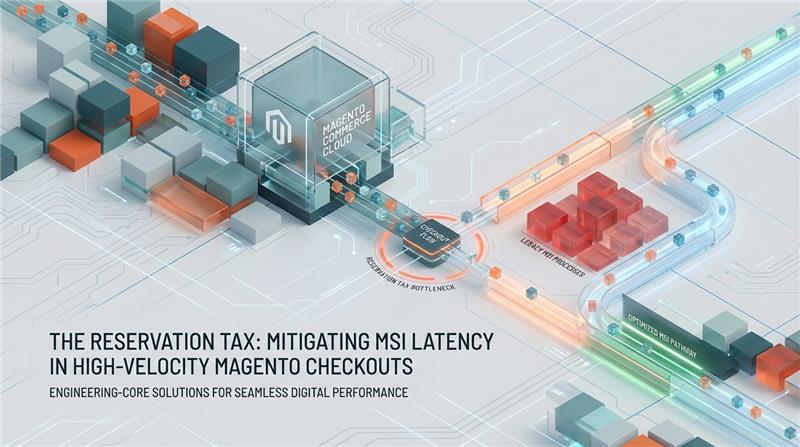
The Reservation Tax : Mitigating MSI Latency in High-Velocity Magento Checkouts
The architecture of Magento 2’s Multi-Source Inventory (MSI) represented a significant leap forward for complex logistics. It introduced the ability to map physical warehouses to digital stocks, enabling shipment matching algorithms that were previously impossible without heavy customization.
However, for high-velocity merchants—those running flash sales, hyped product drops, or handling massive seasonal spikes—MSI introduced a hidden architectural cost. We call this the Reservation Tax.
The Reservation Tax is a latency penalty inherent to the GetSalableQuantity interface. Unlike traditional inventory lookups, which read a static integer, MSI calculates availability dynamically. Under low load, this cost is negligible. Under high concurrency, specifically during write-heavy events, this mechanism creates a feedback loop of latency that scales linearly (or worse) with order volume, frequently resulting in checkout deadlocks.
At Azguards Technolabs, we specialize in resolving these high-stakes engineering bottlenecks. This analysis dissects the specific failure mode of the inventory_reservation table and outlines two engineering paths to mitigate it: a database-level optimization and a Redis-backed architectural overhaul.
1. The Anatomy of the Bottleneck: GetSalableQuantity
To understand the latency trap, we must look at how Magento determines if a product is buyable.
In the legacy CatalogInventory module, stock was a simple integer decrement on a specific row. In MSI, to support concurrent checkouts without immediate row-locking on the primary stock table, Magento introduced the concept of Reservations.
The Dynamic Equation
When a Lead Engineer looks at the Magento\InventorySalesApi\Api\GetProduct SalableQtyInterface, they are not looking at a getter method for a stored value. They are triggering a calculation.
The formula for Salable Quantity is:
- Source Items: The physical stock count in your warehouse, stored in
inventory_source_item. This value is static until a shipment is officially processed or an API update occurs. Reservations: An append-only ledger of “pending” deductions (negative values) and “compensations” (positive values) stored in the
inventory_reservationtable.
The SQL Overhead
The implementation class, Magento\InventorySales\Model\GetProductSalableQty, translates this equation into a SQL query. To determine if SKU PROD-123 can be added to the cart, Magento executes an aggregation operation:
This is the root of the Reservation Tax.
In a standard B2B scenario with 50 orders an hour, the inventory_reservation table is small. The database engine sums the rows instantly.
However, during a flash sale, the following sequence occurs:
- Throughput Spike: Thousands of users attempt to add items to their carts simultaneously.
- Table Growth: Every “Add to Cart” and “Place Order” event inserts a new row into
inventory_reservation. - Complexity degradation: As
N(rows) increases, the cost of theSUM()operation rises. The Penalty: The database CPU spikes as it repeatedly aggregates thousands of rows for the same SKU for every concurrent user.
This creates a compounding latency effect. The 10,000th customer in the queue pays a significantly higher “computation tax” to check stock than the 1st customer, simply because there are more reservation rows to aggregate.
2. "Reservation Debt" and the Failure of Cleanup
Magento is aware of this potential bloat. The system includes an asynchronous consumer, inventory_cleanup_reservations, designed to prune the table.
The cleanup logic identifies reservation sequences that resolve to zero. For example, if an order is placed (-1) and subsequently shipped (+1 deduction from Source Item, effectively canceling the reservation logic), the net reservation is 0. The consumer deletes these rows to keep the table light.
For high-velocity merchants, this cleanup mechanism fails for three specific reasons, leading to what we term Reservation Debt.
1. Throughput Mismatch
The cleanup consumer operates on a Cron schedule or as a daemon. In a flash sale scenario, the ingress rate (New Orders) often exceeds the egress rate (Cleanup).
If your checkout is processing 500 transactions per second, but the cleanup consumer is configured to batch-process 50 sequences per second, the table grows indefinitely. You are accumulating debt faster than you can pay it off.
2. Locking Contention
The most critical failure mode is database locking.
The Checkout Process is trying to INSERT new rows into inventory_reservation to reserve stock.
The Cleanup Consumer is trying to DELETE rows from inventory_reservation to free up space. On high-volume InnoDB tables, this contention frequently triggers Gap Locks or lock wait timeouts. The cleanup job, being a background process, often loses this contention or stalls, effectively pausing cleanup entirely during the peak of the sale—exactly when it is needed most.
3. Index Thrashing
As the table grows to millions of rows during a massive event, the constant insertion and deletion (if cleanup is running) causes significant index fragmentation and thrashing, further degrading the performance of the SUM() query.
3. Solution A: Redis-Backed Atomic Counters (Recommended)
For enterprise merchants targeting 1,000+ orders per minute, relying on SQL aggregation for inventory checks is an architectural dead end. The latency of an O(N) SQL operation cannot compete with the requirements of a high-concurrency checkout.
The engineered solution is to bypass the SQL SUM() entirely for the critical path. We recommend implementing Redis-Backed Atomic Counters.
Architecture Overview
This approach decouples the check from the record.
- Hydration: Upon deployment or prior to the sale event, the calculated Salable Quantity is loaded into Redis keys (e.g.,
stock:salable:sku:PROD-123). - Atomic Check-and-Decrement: When a user adds an item to the cart, we use a Lua script to atomically check availability and decrement the counter in Redis. This happens in O(1) time.
Async Persistence: Once the Redis decrement returns success, the reservation event is pushed to a RabbitMQ queue. A background worker picks up this message and performs the standard
INSERTinto the MySQLinventory_reservationtable for order fulfillment purposes.
The Implementation Pattern (Lua)
Using Lua is non-negotiable here. It ensures the “Check” and the “Decrement” happen as a single atomic operation, preventing race conditions (overselling) without the need for database row locks.
Engineering Benefits
Zero Locking: Redis is single-threaded and atomic. There are no row locks or gap locks to contend with.
Constant Time (O(1)): The latency for the 1st customer and the 100,000th customer is identical (~0.2ms).
4. Solution B: Database Optimization (Mitigation)
If a full architectural decoupling to Redis is out of scope for the immediate timeline, specific optimizations can be applied to the existing SQL architecture to raise the ceiling of the Reservation Tax.
1. Partitioning inventory_reservation
The primary drag on the SUM() query is the working set size. By partitioning the inventory_reservation table, we can reduce the number of rows scanned by the database engine.
Strategy: Hash Partitioning by stock_id or sku. For a multi-website setup, partitioning by stock_id ensures that queries for the US store do not scan reservation rows belonging to the EU store.
Strategy: Range Partitioning by Date. This allows for faster cleanup. Instead of DELETE operations (which are expensive row-by-row transactions), old partitions containing processed reservations can simply be dropped.
2. Tuning the Cleanup Consumer
The default Magento configuration is often too conservative for high-velocity events. To clear Reservation Debt effectively, we must tune the consumer via di.xml.
Batch Size: Increase the batch_size argument for the cleanup consumer. Moving from the default (often 100) to 500 or 1,000 reduces the transaction overhead, provided your database memory can handle the larger buffer.
Process Isolation: Convert the cleanup cron into a daemonized worker (using tools like Supervisor or Systemd). This ensures it runs continuously rather than waiting for Cron ticks.
5. Theoretical Engineering Model: SQL vs. Redis
At Azguards, we model system behavior under load to predict failure points. The following model estimates latency under “Flash Sale” conditions: 5,000 concurrent users, with the reservation table growing by 10,000 rows per minute.
| Metric | Standard MSI (SQL) | Redis-Offloaded (Atomic) |
|---|---|---|
| Complexity | O(N) (Where N = pending reservations) | O(1) (Constant) |
| Latency (Empty Table) | ~0.5 ms | ~0.2 ms |
| Latency (1M Rows) | 50 - 200 ms (High Variance) | ~0.2 ms |
| Locking Behavior | Row/Gap Locks on INSERT/DELETE | Atomic (No Locks) |
| Throughput Ceiling | ~300-500 orders/sec (DB CPU bound) | >10,000 orders/sec (Network bound) |
| Failure Mode | Database Deadlocks (503 Errors) | Queue Lag (Eventual Consistency) |
Analysis of Failure Modes
SQL Failure: When the SQL approach fails, it fails catastrophically. The database CPU hits 100%, causing a cascading failure that takes down not just the checkout, but the admin panel and browsing experience as well.
Conclusion: Decoupling for Scale
The “Reservation Tax” is a classic example of an architecture that works perfectly in theory (or low volume) but breaks down under the physics of high scale.
For standard B2B implementations or low-volume B2C stores, the standard SQL implementation of MSI is robust and sufficient. The data integrity provided by Foreign Keys and ACID compliance in MySQL outweighs the latency cost.
However, for high-velocity commerce, strict ACID compliance on the inventory read path is a liability. By moving the availability check to an in-memory, atomic store (Redis) and relegating the ledger updates to an asynchronous process, we eliminate the linear scaling cost of the SUM() operation.
Azguards Technolabs: Engineering the Hard Parts
Identifying these bottlenecks requires more than just a code review; it requires a deep understanding of database internal structures, locking mechanisms, and distributed systems.
At Azguards Technolabs, we do not just build stores; we engineer infrastructure for resilience. We partner with enterprise engineering teams to perform Performance Audits and Specialized Engineering implementations.
If your platform is struggling to handle peak load, or if you are planning a high-profile product drop that cannot afford to fail, we invite you to discuss your architecture with us. We solve the problems that standard implementations create.
Would you like to share this article?
Request a Performance Architecture Review
All Categories
Latest Post
- The Memory Leak in the Loop: Optimizing Custom State Reducers in LangGraph
- The Reservation Tax : Mitigating MSI Latency in High-Velocity Magento Checkouts
- Mitigating Crawl Budget Bleed: Detecting Faceted Navigation Traps via Python Generators
- The Catch-Up Tax: Preventing Page Cache Eviction during Kafka Historical Reads
- The Consistency Gap: Unifying Distributed ISR Caching in Self-Hosted Next.js
