
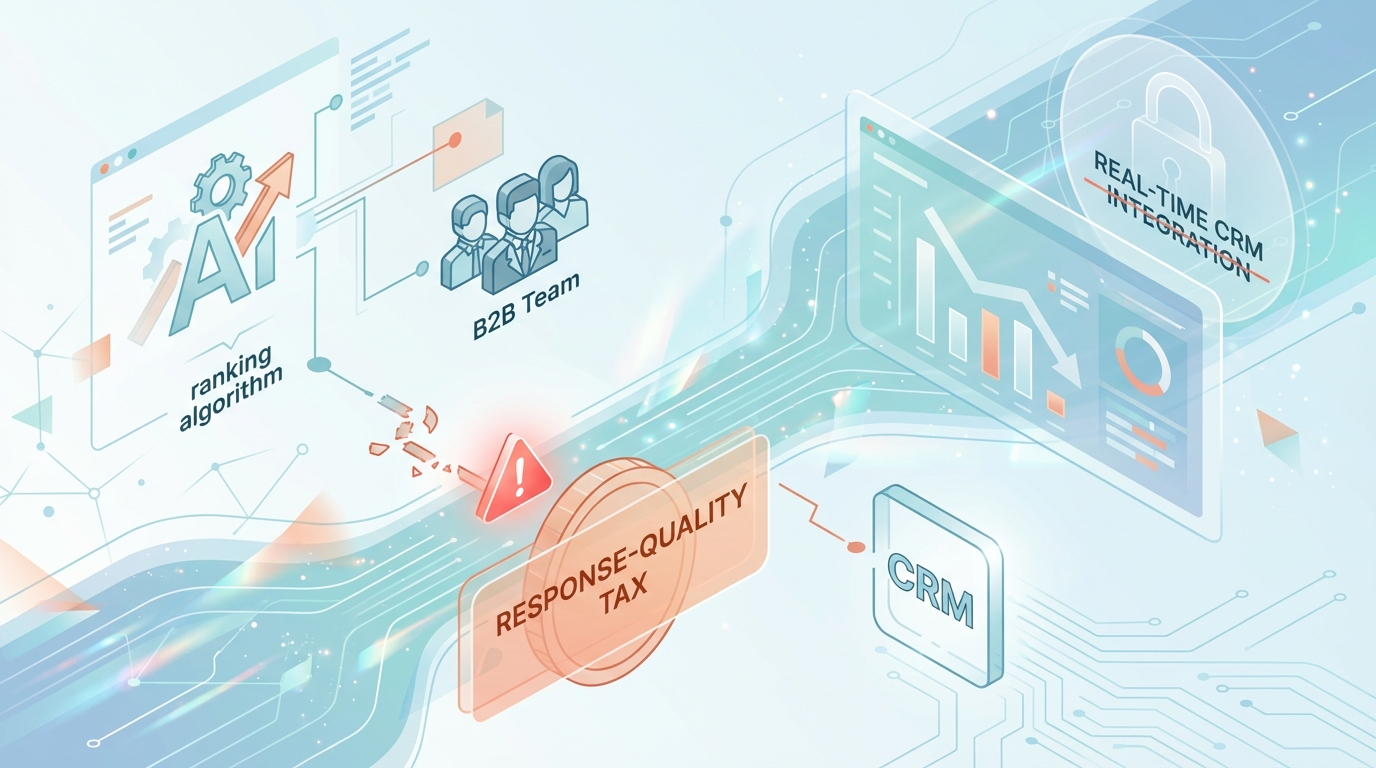
The Response-Quality Tax: Why Meta’s New AI Ranking is Penalizing B2B Teams Without Real-Time CRM Integration
For years, a slow reply on WhatsApp was simply an annoyance. It meant a frustrated lead or a delayed deal, but the platform itself didn’t punish you for it.
That era is ending.
The “Response-Quality Tax” is real, and it is going into effect in 2025.
- Starting July 1, 2025, Meta is shifting the WhatsApp Business pricing model. While many businesses are focused on per-conversation costs, the most critical change lies in the service window: service conversations will only remain free if they happen within a 24-hour window.
- Simultaneously, Meta’s new AI ranking algorithms for business messaging are actively penalizing accounts with low “responsiveness scores.” If your team relies on a single physical phone or disconnected data to reply to customers, you are effectively paying a “tax”—both in higher direct messaging costs and significantly lower visibility.
- Here is what you need to know to tax-proof your B2B strategy.
The New Rules of the Road: July 2025 and Beyond
To understand why your current workflow might be a liability, you have to look at how Meta is redefining “quality” on the WhatsApp Business Platform.
1. The 24-Hour “Free” Window is Hardening
- Historically, the 24-hour service window was a guideline for customer engagement. Starting in July 2025, it becomes a financial gatekeeper. If a customer messages you and your team fails to reply within 24 hours, the window closes. To reopen that conversation, you must pay for a new template message.
Simply put: Slow teams will pay a fine for every late reply.
2. Meta’s AI Ranking Prioritizes “Velocity”
Meta’s algorithm is getting smarter. The new AI ranking system for business messaging heavily weighs response time and block rates when determining a business’s Quality Rating.
- If your responses are slow (causing customers to lose interest) or irrelevant (causing customers to block you), your Quality Rating drops. Accounts with low ratings face strictly enforced daily messaging limits and a higher risk of template rejection.

The 3 Ways You Are "Taxing" Your Own Growth
If you are managing WhatsApp without a centralized infrastructure, you are likely already paying this tax in three different ways.
1. The Financial Tax
This is the direct cost of inefficiency. Every time your team misses the 24-hour service window because a rep was in a meeting, asleep, or simply overwhelmed, you are forced to pay for a template message to continue the chat. For high-volume B2B teams, these micro-charges accumulate into a significant monthly expense that is entirely avoidable.
2. The Visibility Tax
This is the hidden cost imposed by the algorithm. When your responsiveness score dips, Meta throttles your reach. You may find that your promotional broadcasts are delivered slower or that your account is flagged, preventing you from scaling your outreach just when you need to drive revenue.
3. The Conversion Tax
In B2B sales, speed is the primary differentiator.
80% of B2B interactions now happen on digital channels.
50% of B2B sales go to the vendor that responds first.
- If your “speed to lead” is dependent on a human noticing a notification on a physical phone, you aren’t just paying Meta; you are handing 50% of your potential deals to competitors who use automation.
How to "Tax-Proof" Your B2B Strategy
To avoid these penalties, businesses must move away from ad-hoc management and treat WhatsApp as a primary revenue channel. This requires infrastructure that ensures speed without sacrificing context.
Here is how Whatatalk helps B2B teams solve these specific bottlenecks.
1. Eliminate the “Siloed Phone” Bottleneck
The biggest risk to the 24-hour window is the single point of failure: the physical phone. If the rep holding the phone is unavailable, the clock ticks down.
The Solution: Whatatalk Shared Team Inbox
Whatatalk eliminates the bottleneck by allowing unlimited agents to manage a single WhatsApp number from a unified dashboard.
Chat Assignment ensures every incoming message is immediately routed to an active agent.
Internal Team Notes allow managers to guide reps without leaving the chat interface, ensuring the reply is sent fast and accurately.
2. Automate the “Hello” to Stop the Clock
B2B buyers expect answers instantly, even at 2 AM. However, human agents need sleep. Missing after-hours messages hurts your Meta Responsiveness Score and risks the 24-hour pricing window expiring before your team logs in the next morning.
The Solution: AI-Powered Auto Responders
- Whatatalk allows you to deploy
AI Auto-Responders and Chatbots that reply instantly (0-minute delay). This “stops the clock” on the response time metrics, satisfying the algorithm and keeping the service window open until a human can take over.
3. Unify Data to Prevent the “Context Gap”
Speed is dangerous if it lacks context. A fast reply that asks, “Who is this?” frustrates leads and leads to blocks—which tanks your Quality Score.
The Solution: WhatsApp CRM Integration
- Whatatalk acts as a specialized WhatsApp CRM. By using Dynamic User Variables, your agents can see exactly who the lead is, their company details, and their pipeline stage directly in the chat interface. This allows your team to send personalized, relevant responses in seconds, ensuring that velocity never comes at the cost of quality.
Speed is no longer just a metric; it is a currency. With the July 2025 updates, Meta is effectively monetizing time. The difference between a profitable quarter and a costly one may simply come down to whether your infrastructure allows you to respond within that critical 24-hour window.
Don’t let your infrastructure bankrupt your strategy. Equip your team with the tools to respond faster, collaborate better, and avoid the response-quality tax.
Would you like to share this article?
All Categories
Latest Post
- HPOS Migration Under Fire: Eliminating WooCommerce Dual-Write IOPS Bottlenecks at Scale
- The Alignment Cliff: Why Massive Python Time-Series Joins Trigger OOMs — and How to Fix Them
- The Carrier Pinning Trap: Diagnosing Virtual Thread Starvation in Spring Boot 3 Migrations
- The Event Loop Trap: Mitigating K8s Probe Failures During CPU-Bound Transforms in N8N
- The Checkpoint Bloat: Mitigating Write-Amplification in LangGraph Postgres Savers
