
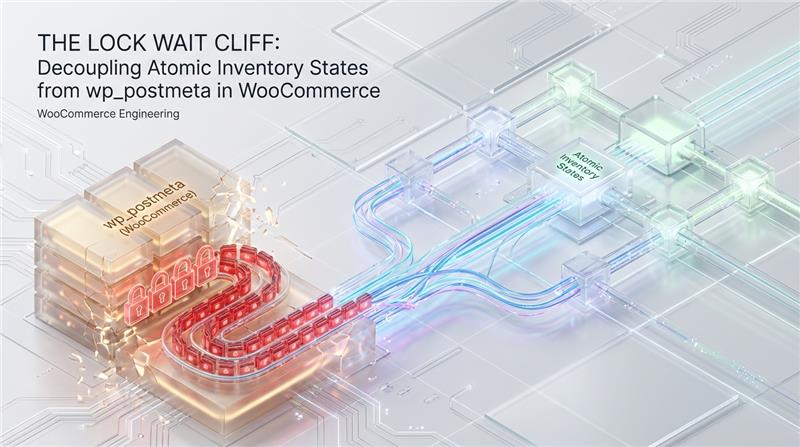
The Lock Wait Cliff: Decoupling Atomic Inventory States from wp_postmeta in WooCommerce
The moment a highly anticipated product drops, enterprise e-commerce systems face a brutal physics problem. When transaction velocity exceeds the database’s ability to sequence write operations, systems do not degrade gracefully—they violently collapse.
In enterprise WooCommerce environments handling high-concurrency checkouts (>500 orders/minute for a single SKU), the default inventory management architecture reliably triggers a cascading failure pattern we call the “Lock Wait Cliff.”
The complication lies deep within the core architecture of WooCommerce: the reliance on MySQL’s InnoDB storage engine to guarantee transaction atomicity during inventory deduction. By tightly coupling the HTTP request lifecycle to synchronous relational database writes, the system mathematically guarantees thread exhaustion under load.
The resolution requires a fundamental architectural shift. To achieve high-throughput inventory allocation, we must entirely bypass the Entity-Attribute-Value (EAV) relational bottleneck. The inventory “source of truth” for in-flight transactions must be decoupled from MySQL, offloading write-heavy concurrency to an in-memory Redis Reservation Buffer, and deferring persistence through background asynchronous workers.
This is how you re-architect WooCommerce to survive a hype-drop.
Failure Mode Analysis: Anatomy of the Lock Wait Cliff
The bottleneck originates in a specific method: WC_Product_Data_Store_CPT::update_product_stock().
To prevent race conditions and overselling during checkout, WooCommerce executes a direct UPDATE query against the wp_postmeta table (modifying the _stock key) and synchronizes this state to wc_product_meta_lookup. While mathematically sound for low-to-medium traffic, this design is fatal at high velocity.
The Mechanical Failure Path:
- InnoDB X-Locks: When the
UPDATEstatement fires, InnoDB acquires an Exclusive (X) record lock on the specificpost_idrow inwp_postmetaand the corresponding row inwc_product_meta_lookup. Until the transaction commits, no other process can mutate—or even read, depending on isolation levels—that row. - Thread Queuing: Assume 500 concurrent checkout requests for a single SKU hit the server in a one-minute window. Exactly 1 thread acquires the X-lock. The remaining 499 threads instantly enter the InnoDB lock wait queue.
- FPM Pool Exhaustion: This is where the database bottleneck becomes an infrastructure catastrophe. HTTP requests blocked by MySQL wait states continue to consume PHP-FPM workers. Enterprise instances typically tune
pm.max_childrenbetween 50 and 200. Once the number of blocked requests exceedspm.max_children, the PHP application layer can no longer accept new connections. Nginx cannot route incoming requests. - Cascading Drop: The system returns 502/504 Bad Gateway errors globally. Because the entire FPM pool is saturated waiting for a single SKU’s row lock, the outage takes down the entire storefront—affecting users browsing unrelated categories, managing their accounts, or attempting to view the homepage.
- Hard Limits Hit:
innodb_lock_wait_timeout: This value defaults to 50s. At 500 requests per minute, database connections pile up exponentially faster than they time out, rapidly exhausting MySQLmax_connections.pm.max_children: FPM worker pool saturation occurs within milliseconds of a hype-drop.
The system has walked off the Lock Wait Cliff.
Architectural Solution: The Redis Reservation Buffer
You cannot tune your way out of an architectural bottleneck. Increasing pm.max_children or upgrading MySQL hardware merely delays the cliff by milliseconds. The only solution is to stop using MySQL as the real-time source of truth for high-velocity state changes.
The optimal pattern is implementing an in-memory Reservation Buffer using Redis.
The Execution Strategy:
- Pre-warming: Inventory quantities are proactively hydrated into Redis during product publish or stock update events.
- Optimistic HTTP Path: During the HTTP checkout lifecycle, we explicitly intercept and bypass
wc_update_product_stock. Instead of hitting MySQL, the application executes an atomic Lua script that decrements the pre-warmed Redis key. - Deferred Persistence: Upon a successful decrement in Redis, the HTTP thread is free to complete the order. Before terminating, it enqueues an asynchronous synchronization job to the Action Scheduler.
- Background X-Locks: Background workers pick up the sync jobs and execute the heavy MySQL EAV updates. Because these workers run via dedicated WP-CLI daemon processes entirely outside the HTTP request lifecycle, X-locks no longer block web server threads or consume
pm.max_children.
Hard Limit Configurations for the Buffer Layer
Executing this pattern safely requires strict infrastructure configurations. A misconfigured Redis cluster will result in massive overselling.
Strict OOM Policy: Redis must be set to maxmemory-policy noeviction. If Redis hits its memory limit and evicts a stock key via LRU (Least Recently Used), the application’s fallback logic will reload the stale MySQL state. Because the deferred background jobs haven’t finished updating MySQL, the stale state will be artificially high, resulting in severe overselling. Redis must throw an OOM error rather than silently drop inventory state.
TCP Keepalive: Set tcp-keepalive 60 in redis.conf. Load balancers and stateful firewalls will silently drop idle connections during traffic lulls. When the hype-drop hits, PHP workers will waste crucial milliseconds attempting to write to dead TCP sockets.
PHP Redis Extension: The application layer must use PhpRedis compiled in C, configured with a strict read_timeout=0.2s. If the Redis cluster hangs, the circuit breaker must fail fast. Hanging for seconds on a blocked Redis operation will simply recreate the FPM exhaustion we are trying to avoid.
Code-Level Implementation: Guaranteeing Atomicity with LUA
A common mistake when moving state to Redis is relying on optimistic locking (WATCH, MULTI, EXEC) to prevent race conditions. Optimistic locking degrades severely under high contention. If 500 threads try to mutate a key simultaneously, 499 will trigger a WATCH failure, requiring infinite retry loops that generate massive CPU overhead and network round-trips.
Instead, we use a custom Lua script executed via EVALSHA. Redis guarantees that Lua scripts execute atomically within its single-threaded event loop. This achieves a single blocking Redis operation while preventing sub-zero stock conditions, with zero network round-trip overhead.
Asynchronous MySQL Sync via Action Scheduler
Once the memory layer confirms the stock allocation, the HTTP process must immediately hand off the persistent MySQL update.
We hook into woocommerce_checkout_order_processed to push the payload to the Action Scheduler. This decouples the time-consuming relational database write from the user’s checkout latency.
Action Scheduler Optimization Limits
The Action Scheduler is a powerful queue, but its default configuration is lethal at scale. By default, it processes queues asynchronously by firing a non-blocking HTTP loopback request to admin-ajax.php. Under heavy load, this routes background database work right back into your PHP-FPM pool, triggering the exact exhaustion we engineered this solution to avoid.
You must completely decouple the queue runner from web traffic:
- Disable the Default Runner: Add
add_filter( 'action_scheduler_run_schedule', '__return_false' );to your mu-plugins. - Daemonize via WP-CLI: Run continuous background processes at the operating system level using systemd or Supervisor:
- Strict Claim Limits: You must limit the concurrency of your background workers to prevent deadlocks on the
wp_actionscheduler_claimstable. Set your concurrent WP-CLI runners to a strict integerN, whereN <= MySQL innodb_thread_concurrency / 4.
State Drift & Failure Recovery (Edge Cases)
When you decouple persistence, you inherently accept the complexities of distributed systems. With Redis acting as the source of truth for in-flight checkouts, asynchronous job failures will eventually create state drift between Redis and MySQL.
1. The Drift Scenario
If an Action Scheduler job fails (due to hardware interruption, memory exhaustion, or reaching max retries), Redis correctly reflects the newly lowered stock, but MySQL remains artificially high.
If a system deployment or node restart triggers a Redis flush, the stale MySQL data will rehydrate into the buffer layer. The system will suddenly believe it has more inventory than exists in the warehouse.
2. The Reconciliation Daemon (The Diff Checker)
To ensure data integrity, implement a WP-CLI CRON job that runs periodically to detect and aggressively resolve state drift.
Reconciliation Logic:
- Aggregate pending reductions mathematically from the
wp_actionscheduler_actionstable for a specificproduct_id. - Calculate the Theoretical MySQL State:
Expected_MySQL = Redis_State + Pending_AS_Reductions - Compare expected versus actual: If
Actual_MySQL_State != Expected_MySQL, you have a dropped job. - Resolution: Force a downward override of the MySQL state, utilizing the authoritative Redis state as the anchor.
3. Split-Brain & Disaster Recovery
Distributed systems require defensive engineering against node failure.
If the primary Redis node drops and Sentinel/Cluster failover takes >100ms, the decrement_stock method will throw a RedisException.
The Fallback Strategy: Your first instinct might be to wrap the Redis call in a try/catch and fall back to the native, synchronous MySQL decrement. Do not do this.
Falling back to MySQL during a high-concurrency event will instantaneously trigger the Lock Wait Cliff, taking down the entire cluster.
Instead, catch the exception, gracefully pause checkouts for the affected SKU, and return a temporary “High Traffic – Please Wait” UI to the client. Retain FPM availability at all costs until the Redis cluster achieves quorum and restores the buffer.
Performance Benchmarks: Before vs. After
The impact of shifting from synchronous EAV writes to an atomic Redis Reservation Buffer fundamentally alters the throughput profile of the WooCommerce checkout API.
| Metric (At 500 orders/min) | Legacy (Direct MySQL) | Optimized (Redis Buffer) |
|---|---|---|
| Inventory Source of Truth | MySQL (wp_postmeta) | Redis Core |
| Transaction Atomicity | InnoDB X-Locks | Lua EVALSHA Engine |
| PHP-FPM Worker Utilization | 100% (Pool Exhausted) | < 15% (Instant Release) |
| p99 Checkout Latency | > 50,000ms (Timeout) | ~ 120ms |
| Database Lock Wait Queue | 499 Blocked Threads | 0 Blocked Threads |
| Global Error Rate | System-wide 502/504 Outage | 0% (Stable Checkouts) |
By isolating the slow relational writes to background WP-CLI daemons, the web tier is free to process HTTP requests at the maximum velocity the Redis engine will allow, bounded only by network latency rather than disk I/O.
Partnering for Enterprise Performance with Azguards Technolabs
Achieving this level of transactional integrity requires more than installing caching plugins; it demands a fundamental re-architecture of how your infrastructure handles state mutation.
At Azguards Technolabs, we specialize in the hard parts of engineering. We serve as the primary partner for enterprise teams requiring Performance Audits and Specialized Engineering for their WooCommerce infrastructure. When off-the-shelf software encounters the absolute limits of its foundational architecture, our Principal Engineers step in to decouple, scale, and secure the operational flow.
We don’t guess at bottlenecks. We profile the complete application lifecycle, mapping precisely where memory, database locks, and thread exhaustion threaten your revenue. From implementing atomic Lua buffers to rewriting heavy EAV database transactions into streamlined background queues, we design systems built specifically for extreme concurrency.
conclusion
The Lock Wait Cliff is an inevitable mathematical outcome of relying on synchronous relational databases to sequence high-velocity transactional state. By decoupling the inventory source of truth into an atomic Redis Reservation Buffer, and deferring persistence via strictly managed WP-CLI daemons, you shift the bottleneck entirely off the web application tier.
You trade the immediate risk of thread exhaustion for the managed complexity of distributed data reconciliation. For an enterprise WooCommerce platform, this is the only viable path to surviving a high-traffic SKU drop.
Need to solve a complex concurrency bottleneck? Contact Azguards Technolabs today for a comprehensive architectural review and specialized implementation roadmap for your infrastructure.
Would you like to share this article?
Ready to Move Off the Lock Wait Cliff?
At Azguards Technolabs, we design and implement high-concurrency inventory systems that eliminate lock waits, prevent FPM exhaustion, and protect revenue during hype drops.
All Categories
Latest Post
- HPOS Migration Under Fire: Eliminating WooCommerce Dual-Write IOPS Bottlenecks at Scale
- The Alignment Cliff: Why Massive Python Time-Series Joins Trigger OOMs — and How to Fix Them
- The Carrier Pinning Trap: Diagnosing Virtual Thread Starvation in Spring Boot 3 Migrations
- The Event Loop Trap: Mitigating K8s Probe Failures During CPU-Bound Transforms in N8N
- The Checkpoint Bloat: Mitigating Write-Amplification in LangGraph Postgres Savers
