
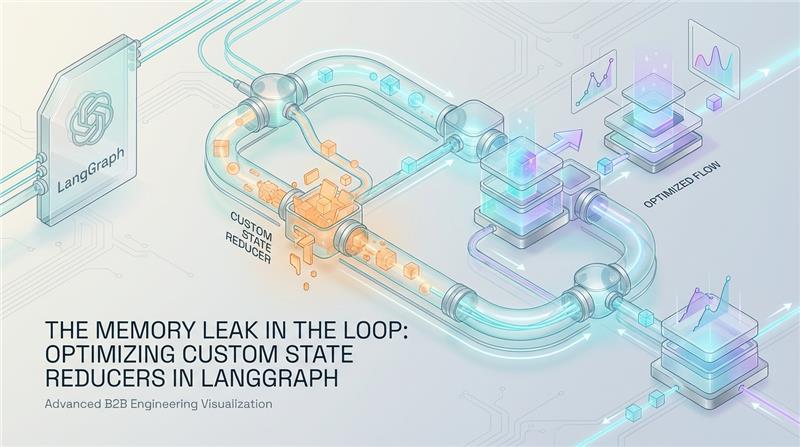
The shift from Directed Acyclic Graphs (DAGs) to cyclic, agentic workflows represents the current frontier of AI engineering. We are no longer building pipelines; we are building loops—Reflect, Revise, Critique, Repeat.
However, moving to recursive architectures exposes a critical fragility in the default LangGraph primitives. While excellent for prototyping, the standard state management utilities often function as silent technical debt generators when deployed in long-running loops.
The culprit is hidden in plain sight: Annotated[list, add_messages].
For a Senior AI Engineer, understanding the mechanical implications of this reducer is the difference between a resilient, cost-effective agent and one that hemorrhages tokens, hits context limits, and introduces massive latency spikes after just a dozen iterations.
This engineering deep-dive analyzes the “Context Bloat” phenomenon in LangGraph and prescribes two architectural patterns to solve it: Milestone-Based Rolling Windows and Dual-Channel Ephemeral State.
1. The Anatomy of a Context Leak
In LangGraph, state is immutable. To simulate memory, we pass state between nodes, applying updates via “reducers.” The default reducer for chat history is add_messages.
Mechanically, add_messages implements a CRDT-like (Conflict-Free Replicated Data Type) merge strategy. It handles ID deduplication effectively, but its retention policy is Append-Only. It never deletes data unless explicitly instructed via a RemoveMessage signal—a signal that is rarely implemented in standard recursive reasoning loops.
The O(N2)O(N2) Failure Mode
Consider a standard “Self-Correction” loop where an agent generates code, runs it, captures the error, reflects, and retries.
In a while loop structure, every iteration appends the full intermediate reasoning chain to the messages key.
Iteration 1: Prompt + Code + Error (1,000 tokens)
Iteration 2: Prompt + Code + Error + History(Iter 1) (2,000 tokens)
Iteration 3: Prompt + Code + Error + History(Iter 1+2) (3,000 tokens) While the memory growth is linear O(N)O(N), the token consumption is quadratic O(N2)O(N2) because the entire history is re-serialized and re-injected into the LLM’s context window at every single step.
The Hard Limit
If you run a 20-step loop where each step generates 1,000 tokens:
Standard Accumulation: You will process approximately 210,000 cumulative tokens.
Latency: Serialization/Deserialization overhead increases linearly. If you are using a Postgres checkpointer, the I/O latency of reading the bloat becomes a bottleneck before the LLM even receives the prompt. This is not sustainable for production systems. We need a retention policy that operates at the storage level, not just the prompt level.
2. Solution A: The Rolling Window + Key Milestones Reducer
The naive solution is to slice the list: messages[-10:]. The problem with the naive solution is context collapse. If you slice the last 10 messages, you delete the System Prompt, the original User Query, and potentially critical tool outputs that occurred early in the session.
We need a deterministic heuristic: Keep the recent context + Keep the “Milestones.”
We replace add_messages with a custom reducer that enforces this policy during the state update.
The Implementation
We define a milestone_reducer that inspects message metadata. We retain messages if they are within the window K OR if they are tagged milestone=True.
Engineering Impact
By tagging the initial HumanMessage and key ToolMessage outputs as milestones, you ensure the agent never forgets “The Goal” or “The Facts,” while effectively garbage-collecting the intermediate chatter. This flattens the memory curve from linear to constant O(1)O(1) (after window saturation).
3. Solution B: "Ephemeral Reasoning" (The Dual-Channel Architecture)
Solution A optimizes the chat history. Solution B fundamentally restructures how the agent thinks.
In complex reasoning tasks (e.g., Code Generation or Legal Analysis), 90% of the tokens generated are “Chain of Thought” (CoT), reflections, or error corrections. Once the final answer is derived, this history is technical debt. It holds no future value.
To reduce token costs by 40-60%, we separate the state into two distinct channels:
- Persistent Channel: The “Main Timeline” (User inputs, Final Answers).
Ephemeral Channel: The “Scratchpad” (Reasoning, Critique, Retry).
The Overwrite Reducer
The Ephemeral Channel utilizes an Overwrite reducer. We do not append; we replace.
The Workflow Logic
This requires a modification to your node logic:
- Reasoning Node: Reads
conversation_history. Writes its thought process toreasoning_scratchpad. - Reflect Node: Reads
reasoning_scratchpad. Generates a critique. Writes a new list toreasoning_scratchpad(wiping the old one). - Finalize Node: Reads
reasoning_scratchpad. Synthesizes the answer. It performs two writes:
- Appends the result to
conversation_history. - Sends
[](empty list) orNonetoreasoning_scratchpadto clear the buffer.
This architecture ensures that the “context window” for the next turn of conversation is pristine. The messy “how I got here” logic is discarded, leaving only the “what I found.”
4. Why Not Just Use Summarization Chains?
A common counter-argument is: “Why not just use an LLM call to summarize the history when it gets too long?”
This is a valid strategy for archiving sessions that span days. It is a terrible strategy for optimizing active hot-loops (sessions spanning minutes).
Comparative Analysis: Custom Reducer vs. Summarization
| Feature | Summarization Chain (LLM) | Custom Reducer (Code) |
|---|---|---|
| Mechanism | Calls LLM to compress history into a string. | Python function filters or slices the list. |
| Latency | High. Requires a full LLM round-trip (generation latency). | Negligible. In-memory list operation (<1ms). |
| Cost | High. Reads N tokens to write summary tokens. | Zero. Pure compute. |
| Fidelity | Lossy. Nuance and specific variable names may be lost. | Exact. Preserves exact message objects/payloads. |
| Use Case | Archiving very old sessions (“Last week we discussed...”) | Optimizing active recursive loops. |
Engineering Recommendation: Use Custom Reducers for active context management. You cannot afford to inject an LLM latency block into every 5th step of a recursive loop.
5. The Performance Benchmark: Theoretical Token Savings
Let’s quantify the impact. We modeled a scenario where an agent enters a “Reflect/Revise” loop for 10 iterations.
Base Prompt: 1,000 tokens.
Reasoning Step: 500 tokens output.
Scenario A: Standard add_messages (Accumulating)
In the default configuration, the agent reads its full history at every step to maintain continuity.
Step 1: Input 1,000 →→ Output 500 (Total State: 1,500)
Step 2: Input 1,500 →→ Output 500 (Total State: 2,000)
…
Step 10: Input 5,500 →→ Output 500 Total Tokens Processed: ∑(1000+500×i)≈37,500 tokens∑(1000+500×i)≈37,500 tokens
Scenario B: Ephemeral Schema (Overwrite scratchpad)
Here, the agent reads the Base Prompt + the current scratchpad content. The previous scratchpad versions are discarded.
Step 1: Input 1,000 (Hist) + 0 (Scratch) →→ Output 500
Step 2: Input 1,000 (Hist) + 500 (Last Scratch) →→ Output 500
…
Step 10: Input 1,000 (Hist) + 500 (Last Scratch) →→ Output 500 Total Tokens Processed: 1,500×10=15,000 tokens1,500×10=15,000 tokens
The Result
~60% Reduction in processed tokens. More importantly, the cost per step in Scenario B is constant. In Scenario A, the cost per step is linear. In a loop that unexpectedly runs for 50 iterations, Scenario A crashes the application. Scenario B continues running with stable latency.
Performance Audit & Optimization
Transitioning from “Demo-Ready” LangGraph implementations to “Enterprise-Scale” architectures requires deep intervention at the state management layer. The default tools are designed for ease of use, not infinite scalability.
At Azguards Technolabs, we specialize in the “Hard Parts” of AI engineering. We don’t just build chatbots; we audit and re-engineer the underlying graph architectures for high-throughput enterprise environments.
If your agentic workflows are suffering from increasing latency, unexplainable costs, or context-window failures, your state schema is likely the bottleneck.
Contact Azguards Technolabs for a comprehensive Architectural Performance Audit. Let’s turn your O(N2N2) leaks into O(1) efficiency.
Stop Appending. Start Managing.
In software engineering, memory leaks are usually caused by failing to release allocated resources. in Agentic AI, the “Context Leak” is caused by failing to release irrelevant tokens.
The default add_messages reducer is an architectural placeholder. It is not a production strategy for recursive agents. By implementing Milestone-Based Reducers and separating Ephemeral Reasoning from Persistent Facts, you gain control over the most expensive resource in the LLM stack: the Context Window.
Would you like to share this article?
Move Beyond "Demo-Ready" Logic
At Azguards Technolabs, we specialize in the “Hard Parts” of AI engineering—re- architecting state schemas to turn technical debt into performance.
