
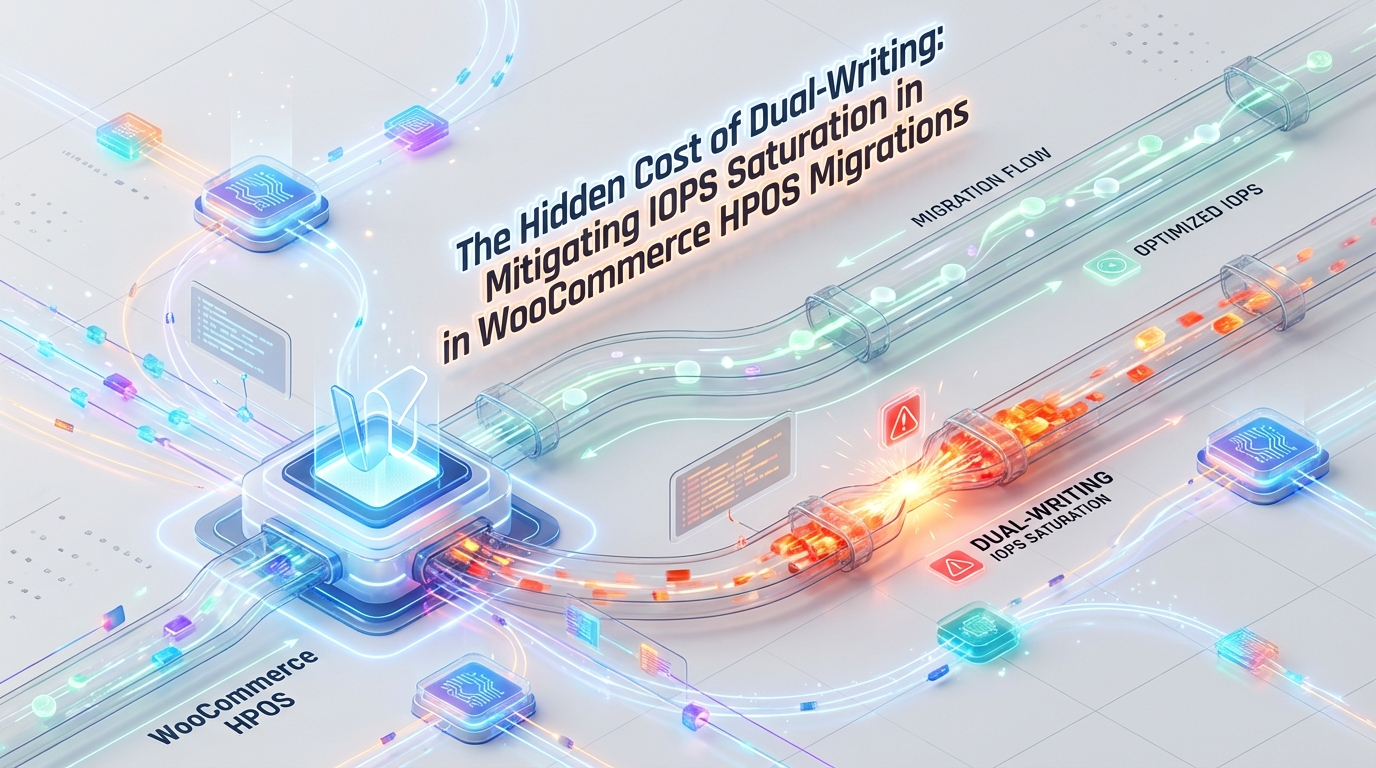
Migrating high-volume WooCommerce architectures to High-Performance Order Storage (HPOS) is a mandatory infrastructural shift for enterprise scaling. By flattening the historic Entity-Attribute-Value (EAV) data model, HPOS drastically reduces the query complexity required to read order data. However, migrating legacy enterprise environments requires maintaining strict backward compatibility with third-party plugins that are not yet HPOS-aware.
To bridge this gap, teams enable “Compatibility Mode,” which invokes the Automattic\WooCommerce\Internal\DataStores\Orders\DataSynchronizer class. This class enforces a strict dual-write state. Every transaction must be mirrored between the optimized HPOS custom tables (wc_orders, wc_order_addresses, wc_order_operational_data, wc_orders_meta) and the legacy WordPress tables (wp_posts, wp_postmeta).
The complication is write amplification. Under standard operational loads, the I/O penalty of this split-brain synchronization is masked by the database buffer pool. However, under flash-sale load conditions—specifically crossing the 50+ Transactions Per Second (TPS) threshold—this dual-writing mechanism transforms into a critical database bottleneck. Disk IOPS saturate, the storage layer throttles, and the database cascades into thread pool exhaustion.
The resolution requires decoupling the synchronization layer from the MySQL thread pool entirely. By circumventing native sync methodologies—including the database-backed Action Scheduler—and implementing an asynchronous, throttled, Redis-backed queue, infrastructure teams can process transactions at flash-sale concurrency while managing the disk I/O cost asynchronously.
Architectural Analysis: DataSynchronizer & Write Amplification
To solve the dual-write penalty, we must first model the raw database execution path. The DataSynchronizer manages state via two execution models: continuous (synchronously blocking the main execution thread) or background (batched via Action Scheduler). Regardless of the execution model, the underlying storage operations remain identical, introducing a compounding I/O penalty.
Let us establish a theoretical engineering model to quantify this disk IOPS saturation during a high-concurrency event.
The IOPS Multiplier per Checkout
During a single checkout execution, the dual-write process triggers the following sequence:
- HPOS Tables: Generating the baseline order requires approximately 5
INSERTstatements distributed across the 4 custom HPOS tables. - Legacy Tables (Sync): The
DataSynchronizersubsequently executes 1 row insert towp_posts(using theshop_orderpost type) and an average of 40 to 50 localized row inserts intowp_postmetato reconstruct the EAV state. - InnoDB Engine Overhead: Row counts do not directly equate to disk operations. Every
wp_postmetainsert triggers secondary index B+Tree page splits. The storage engine must append these modifications to the redo log (ib_logfile), allocate space in the doublewrite buffer to prevent partial page writes, and ultimately flush to the.ibdtablespaces.
Saturation Mathematics at 50 TPS
By calculating the raw operations, the scope of the amplification becomes clear:
Raw Row Writes: ~55 rows per order.
Throughput: At 50 TPS, the database must sustain ~2,750 raw row inserts per second.
IOPS Translation: When accounting for InnoDB engine overhead (ACID compliance, fsync() system calls, binlog synchronizations for replication, and doublewrite buffers), 2,750 row inserts routinely generate 7,500 to 10,000+ disk IOPS.
Hard Limits and the I/O Cliff
Modern cloud architectures, such as AWS EC2 instances backed by EBS gp3 volumes, typically baseline at 3,000 IOPS.
Sustaining a 50 TPS checkout rate immediately forces the EBS volume to consume its burst credits. Once burst credits are exhausted, performance falls off a mathematical cliff, hard-throttling to the 3,000 IOPS baseline.
As disks throttle, the OS registers massive IOWait spikes. Within the MySQL daemon, worker threads queue indefinitely while waiting for innodb_data_pending_fsyncs to clear. If the variable innodb_thread_concurrency is left unbound (the default value of 0), MySQL attempts to clear the backlog by aggressively spawning new threads. This leads to immediate RAM exhaustion or hitting the max_connections limit. The end-user result is database deadlocks, NGINX 502 Bad Gateway errors, and fundamentally, dropped revenue.
The Action Scheduler Anti-Pattern
A standard, yet flawed, fallback strategy is configuring the DataSynchronizer to defer synchronizations using the background mode:
woocommerce_custom_orders_table_background_sync_mode = 'continuous'
This offloads the dual-write payload to WooCommerce’s native Action Scheduler. However, relying on Action Scheduler during a high-concurrency event is an architectural anti-pattern.
Action Scheduler is entirely database-backed. It queues execution jobs directly into the wp_actionscheduler_actions table and writes execution state data into wp_actionscheduler_logs. During a flash sale, shifting the synchronization payload to Action Scheduler does not reduce the write load; it merely redirects it.
At 50 TPS, attempting to queue the sync jobs compounds the write amplification by forcing heavy inserts into the wp_actionscheduler tables. This saturates the EBS volume and locks the database before the actual data synchronization process even begins. Using a database to queue writes for a database that is currently failing due to write saturation is a recursive failure loop.
Mitigation Strategy: Redis-Backed Asynchronous Queue
To maintain backward compatibility for legacy plugins while explicitly preventing IOPS saturation, the synchronization payload must be stripped away from MySQL.
The strategy relies on disabling the native DataSynchronizer background sync and replacing it with a Redis-backed, in-memory queue. This guarantees that the primary checkout transaction is decoupled from the legacy EAV data generation.
Step 1: Intercept and Reroute the Sync Payload
First, disable the database-heavy native background sync. Next, hook directly into the WooCommerce order update lifecycle. Instead of executing MySQL inserts, push the order IDs to an in-memory Redis List using the phpredis extension. Redis operates entirely in RAM, meaning an lPush command completes in sub-millisecond time with zero disk I/O overhead.
Step 2: Implement a Delayed Off-Peak Worker
To process the queue without triggering the original IOPS bottleneck, consume the Redis list using a persistent PHP CLI daemon running via Systemd or Supervisord.
This daemon isolates the synchronization workload. By utilizing Redis’s BRPOP command, the worker process blocks until an item is available, achieving zero CPU idle polling. Crucially, the worker introduces an artificial rate limiter. By enforcing a strict sleep interval, we guarantee the storage engine is never fed more IOPS than its baseline capacity can handle.
MySQL Tuning for High-Concurrency Meta Writes
If bypassing the Action Scheduler is organizationally prohibitive due to existing operational tooling, you must expand the hard limits of the MySQL daemon to survive the write cliff. Default InnoDB configurations are designed for general-purpose workloads, not massive EAV write bursts.
Apply the following configurations to specifically optimize the InnoDB engine for write-heavy HPOS dual-writing.
Benchmarks: Before vs. After Migration
To quantify the architectural shift, we benchmarked the baseline 50 TPS flash-sale payload across three distinct configurations. The data highlights the failure of database-backed queueing and the efficacy of off-thread memory queueing.
| Metric | Native Sync (Continuous) | Action Scheduler (Background) | Redis-Backed Queue (Throttled Worker) |
|---|---|---|---|
| Peak Database IOPS | 7,500 - 10,000+ | 8,200+ (Queue amplification) | < 3,000 (Regulated to EBS baseline) |
| Order Throughput (Max) | 18 TPS before IOWait stall | 22 TPS before DB lockout | 50+ TPS (App layer limited) |
| Storage Bottleneck | EBS Burst Exhaustion | wp_actionscheduler lock contention | Eliminated (Offloaded to RAM) |
| Error Rate (502s) | High (Thread pool exhaustion) | High (Database deadlocks) | 0% |
| Sync Finality | Synchronous | Unpredictable (Cron dependent) | ~5 syncs/sec (Off-peak execution) |
As the metrics indicate, moving to the Redis-backed worker completely eliminates the EBS burst exhaustion risk. By capping synchronization to 5 syncs per second, the application handles the 50 TPS ingestion spike in memory, gracefully draining the sync queue during off-peak windows without destabilizing the database.
Performance Audit and Specialized Engineering
Resolving deep infrastructural bottlenecks requires more than surface-level plugin management. It requires treating WooCommerce not as a monolithic CMS, but as a distributed transaction system.
At Azguards Technolabs, we do not provide standard technical support; we provide Performance Audits and Specialized Engineering for high-stakes environments. We architect solutions that account for kernel-level storage limits, thread pool management, and asynchronous data pipelines. When enterprise teams hit the limits of standard WooCommerce infrastructure, we dissect the application state, map the hardware constraints, and engineer bypass mechanisms that guarantee uptime during your most critical revenue events.
Conclusion
Migrating to HPOS is non-negotiable for the future of WooCommerce, but maintaining legacy plugin compatibility via the DataSynchronizer introduces severe architectural risks. Dual-writing forces an unacceptable level of write amplification, and default tools like Action Scheduler only obfuscate the database bottleneck rather than solving it.
To survive high-concurrency events, engineering teams must decouple state synchronization from the execution thread. Implementing a Redis-backed queue paired with a dedicated CLI daemon ensures that primary transactions write at the speed of RAM, while legacy compatibility is handled at a disk-safe pace. When paired with aggressive InnoDB flush tuning, this architecture guarantees stability regardless of traffic spikes.
If your WooCommerce platform is experiencing IOPS saturation, database deadlocks, or 502 errors during high-volume events, the standard configuration has failed you. Contact Azguards Technolabs for a comprehensive architectural review and complex system implementation. We build infrastructure designed to scale without limits.
Would you like to share this article?
ENGINEERING SYSTEMS THAT DON’T COLLAPSE AT SCALE
If your platform struggles with IOPS saturation, database deadlocks, or unpredictable 502 errors, the problem isn’t traffic — it’s architectural design. Azguards Technolabs engineers high-concurrency systems, asynchronous pipelines, and storage-aware infrastructure built to survive real-world scale.
