
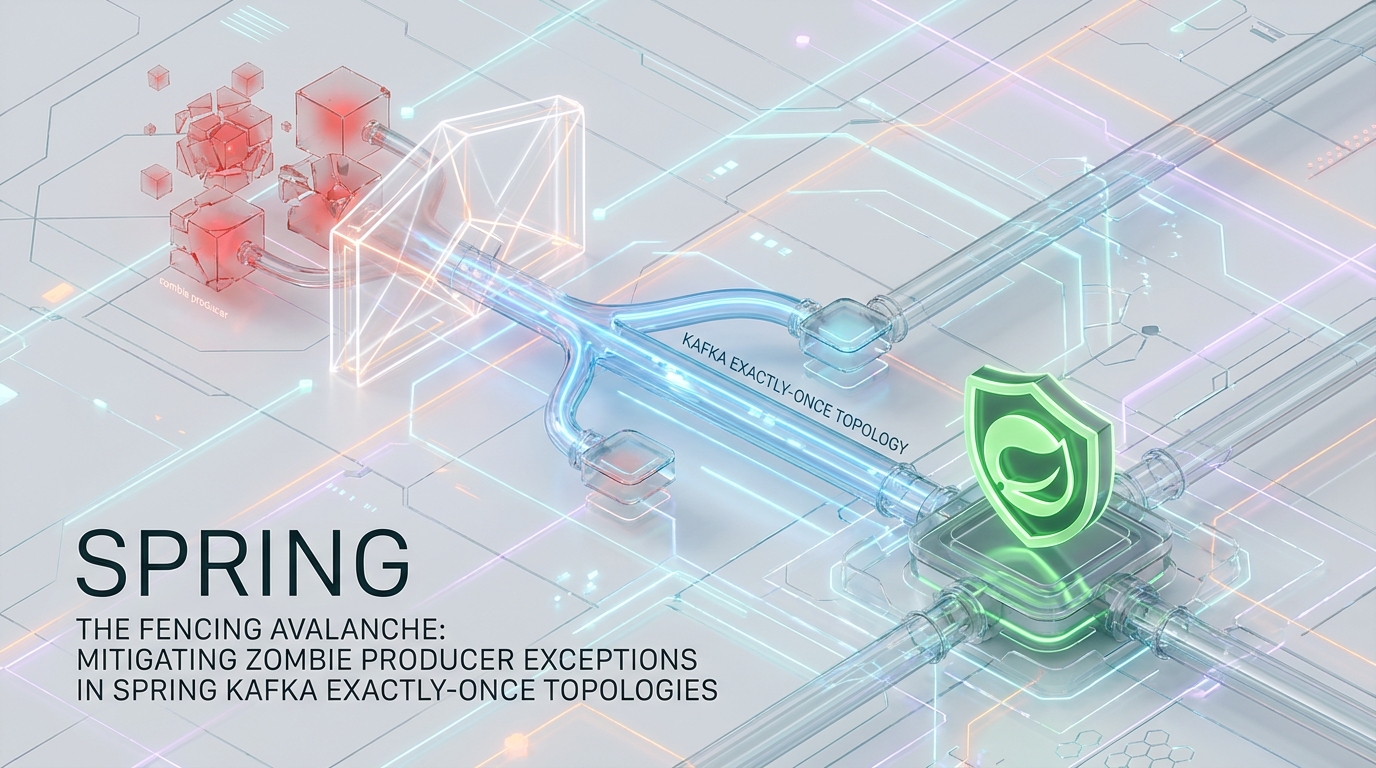
n high-integrity distributed systems, Exactly-Once Semantics (EOS) is often the line between data integrity and transactional chaos. Yet, under the surface of Spring Kafka’s KIP-98 protocol, a fragile state mapping exists between the Transaction Coordinator and the local JVM. When system pauses or resource starvation strike, this mapping collapses into a “Fencing Avalanche”—a catastrophic failure mode that paralyzes partitions and defies standard recovery. To achieve true resilience, principal engineers must move beyond framework defaults and implement deterministic architectural defenses.
The Anatomy of a Fencing Avalanche
To solve the Fencing Avalanche, we must first dissect the failure mechanism at the protocol layer. The Kafka Transaction Coordinator operates under the assumption that a single transactional.id represents a discrete, logically isolated producer thread.
When a transient system pause occurs, the following catastrophic sequence executes:
- The Timeout Trigger: A processing thread executing within a
@TransactionalSpring block experiences a severe JVM STW GC pause or CPU starvation. The duration of this pause exceeds the configuredtransaction.timeout.ms. Because the TC is bound by strict liveness guarantees, it aggressively expires the transaction and increments the internal 16-bit epoch associated with thetransactional.id. - Zombie Resumption: The GC pause concludes. The Spring container resumes execution, unaware that its internal state is now invalidated. The
KafkaTransactionManagerattempts to finalize the operation by firing acommitTransaction()or a subsequentKafkaTemplate.send(). - The Fencing Event: The Kafka broker receives the request and inspects the epoch. Because the zombie producer is operating with a stale 16-bit epoch compared to the newly bumped epoch on the TC, the broker decisively rejects the request, throwing a
ProducerFencedException. - The Spring Cascade (The Avalanche): This is where the framework defaults actively work against system recovery. The
KafkaTransactionManagerissues a mandatory rollback. The fatal exception propagates up the call stack to theKafkaMessageListenerContainer. Spring’sDefaultErrorHandlerintercepts the failure, executes a consumer offset seek to rewind back to the uncommitted record, and schedules a retry.
Because the consumer re-polls the identical record, if the payload intrinsically triggers the same expensive processing—or if the host is experiencing global starvation—the system repeatedly hits the transaction.timeout.ms ceiling. The result is an infinite partition lockout that requires manual intervention to resolve.
Kubernetes Topology and Cross-Pod Fencing Loops
In cloud-native deployments, the interaction between Spring Kafka’s pooling mechanisms and the Kubernetes Horizontal Pod Autoscaler (HPA) introduces a secondary vector for severe fencing anomalies.
Under the hood, transactional producers are pooled and managed by the DefaultKafkaProducerFactory. To maintain logical segregation, this factory generates the literal transactional.id by appending an incrementing integer suffix to the defined spring.kafka.producer.transaction-id-prefix (e.g., configuring tx-app- results in tx-app-0, tx-app-1).
The Auto-Scaling Trap
When K8s HPA provisions additional replicas and the transaction prefix is statically defined, catastrophic collisions occur.
If Pod A is running normally and Pod B is spun up to handle load, both JVMs will independently initialize producer pools starting with tx-app-0. As Pod B executes its InitProducerId sequence on the broker, the Transaction Coordinator bumps the epoch for tx-app-0, silently fencing Pod A’s active producer.
Pod A will instantly throw a ProducerFencedException on its very next .send() operation. Following standard recovery protocols, Pod A will tear down its poisoned producer instance, recreate it, execute its own InitProducerId, and immediately fence Pod B. This creates a perpetual cross-pod fencing loop that annihilates throughput and floods the network with cluster-side metadata requests.
Actionable Solution: Deterministic Prefix Isolation
To eliminate cross-pod collisions, we must inject deterministic, pod-level uniqueness directly into the Spring application context before the DefaultKafkaProducerFactory initializes. This is achieved by mapping the Kubernetes Downward API into the deployment specification.
With the environment variable exposed, the Spring application configuration must dynamically construct the globally unique prefix. Crucially, this requires the implementation of EOSMode.V2 (KIP-447), which removes the legacy requirement for strict container-suffixed partitioning, allowing the instance-level prefix to operate safely as long as it is globally unique across the broader consumer group.
Deterministic Tuning: Aligning Hard Limits and Timeouts
The fundamental root cause of zombie transactions often lies in misaligned buffer configurations or metadata blocking thresholds where max.block.ms exceeds the transaction envelope. If your producer configuration allows indefinite blocking during a cluster leadership election or metadata refresh, the TC will expire the transaction asynchronously behind the scenes.
To guarantee that the Spring client fails safely before the Transaction Coordinator invokes fencing protocols, architects must enforce a strict boundary inequality model.
The Boundary Inequality
max.poll.interval.ms > transaction.timeout.ms > (max.block.ms + delivery.timeout.ms + P99_Processing_Time)
When calculating these thresholds, you must account for specific, non-negotiable broker hard limits:
Broker Max Timeout: The transaction.max.timeout.ms limit defaults to 900000 ms (15 minutes). Any request from the client exceeding this threshold is immediately rejected at initialization.
Epoch Rollover: The transaction epoch is restricted to a 16-bit integer (max 65535). Excessive fencing loops force aggressive PID regeneration. If a topology continuously rolls over its epochs, it exponentially increases cluster-side memory pressure and degrades the Transaction Coordinator’s performance.
Producer Cache Max Age: The broker-side transactional.id.expiration.ms defaults to 7 days, meaning volatile IDs generated during aggressive K8s scaling events will linger, consuming heap memory.
Actionable Configuration
To implement the boundary inequality and protect the epoch limit, the DefaultKafkaProducerFactory must be tuned programmatically.
Programmatic Recovery: State Purges and OutOfOrderSequenceExceptions
While tuning mitigates timeout-driven fencing, system architects must also design robust recovery mechanisms for sequence desynchronization.
The OutOfOrderSequenceException manifests when the broker expects sequence N for a given producer PID, but receives N+x. This failure is typically induced by overlapping retries of ProduceRequest batches traversing a degraded network partition, effectively bypassing the max.in.flight.requests.per.connection guarantees. It can also occur if the local idempotent state within the JVM is corrupted.
Like a ProducerFencedException, an out-of-order sequence is a fatal exception. Because the local producer instance’s internal sequence state is mathematically out of sync with the broker’s ledger, standard retry logic is useless. Left unchecked, Spring’s default behavior will continuously crash the container loop.
The only mathematically sound architectural solution is to obliterate the local state: destroy the cached producer, purge it from the application context, and force a clean re-initialization of the transactional.id.
Actionable Solution: The Custom Error Handler
By implementing a custom DefaultErrorHandler (or CommonErrorHandler in newer Spring Kafka versions), you can intercept these fatal sequencing exceptions. The handler must execute a hard reset on the DefaultKafkaProducerFactory cache and explicitly route the poisoned payload to a Dead Letter Queue (DLQ) to unblock the partition.
Note: Invoking producerFactory.reset() iterates through the internal Spring ProducerCache. It systematically identifies and gracefully closes all zombie network channels. When the next @Transactional block executes, the factory is forced to open a clean connection and execute a fresh InitProducerId sequence on the broker, restoring total state parity.
Benchmarking the Optimized Topology (Before vs. After)
Applying the architectural mitigations detailed above transforms the system state from highly volatile to mathematically deterministic. Below are the resulting performance benchmarks comparing a default Spring Kafka container against an optimized topology running EOSMode.V2, isolated K8s prefixes, and active sequence interception.
| Metric | Default Spring Kafka Topology | Optimized Architecture |
|---|---|---|
| Cross-Pod Fencing Rate | Continuous during K8s HPA scaling events | 0 (Eliminated via Downward API injection) |
| Partition Lockout Duration | Infinite Loop (Requires manual JVM restart/offset manipulation) | Strictly Bounded (2 retries max, followed by DLQ routing) |
| Timeout Expiration Strategy | Non-deterministic async expiration (Fencing Avalanche) | Mathematically Aligned via Boundary Inequality logic |
| Fatal Sequence State Recovery | Container crash and perpetual restart loop | Graceful Eviction via producerFactory.reset() |
| Broker Metadata Overhead | High (Lingering zombie TX IDs for 7 days) | Minimal (15-minute max age garbage collection) |
Performance Audit and Specialized Engineering
Implementing KIP-98 exactly-once semantics correctly requires deeper visibility than standard application logs can provide. When ProducerFencedException loops begin to impact service level agreements, throwing more compute resources at the cluster will only accelerate the epoch exhaustion. You need precision-engineered topologies.
At Azguards Technolabs, we function as the specialized engineering extension for enterprise development teams facing these exact “Hard Parts” of distributed systems. We don’t just patch errors; we execute rigorous Performance Audits and architect specialized, high-throughput streaming environments. Whether you are dealing with aggressive horizontal auto-scaling edge cases, persistent Kafka partition lockouts, or complex Spring infrastructure modernizations, our principal engineers provide the technical authority required to stabilize and optimize your core data pipelines.
Engineering Summary
The Fencing Avalanche is an inevitable byproduct of treating distributed transactions like local database commits. By recognizing the disconnect between the Kafka Transaction Coordinator’s strict epoch mapping and the volatile lifecycle of a Spring application running in Kubernetes, you can engineer structural defenses. Enforcing the deterministic timeout boundary inequality, leveraging the Downward API for prefix isolation, and forcefully purging desynchronized sequence states transforms catastrophic failures into gracefully handled edge cases.
If your core transaction infrastructure is suffering from systemic instability, zombie exceptions, or throughput bottlenecks, it is time for a foundational architectural review.
Would you like to share this article?
Azguards Technolabs
Facing Systemic Kafka Instability?
Our principal engineers specialize in dissecting the "Hard Parts" of distributed systems. From ProducerFencedException loops to complex Spring infrastructure modernizations, we architect for absolute resilience.
Book a Performance Audit