
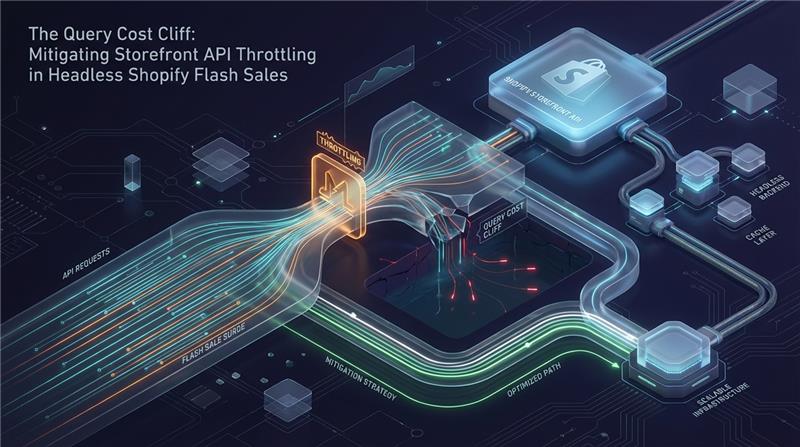
High-concurrency flash sales expose the fragile boundaries of distributed architectures. When operating a headless commerce stack against a multi-tenant SaaS backend, the intersection of heavy read queries and rapid cart mutations creates a volatile execution environment. For teams building on Shopify, the primary bottleneck is rarely the storefront rendering layer; it is the strict deterministic throttling enforced by the Storefront API.
Situation: You are provisioning a headless Shopify environment (Next.js, Remix, or Hydrogen) for a high-velocity flash sale. Traffic is expected to spike from a baseline of 50 requests per second to over 5,000 requests per second within a 60-second window.
Complication: Shopify protects its infrastructure using a rigid leaky bucket algorithm. Deeply nested Product Listing Page (PLP) or Product Detail Page (PDP) queries inflate GraphQL costs exponentially. Crossing the query cost limits results in immediate request termination, cascading 429 Too Many Requests errors, Backend-for-Frontend (BFF) Out-of-Memory (OOM) crashes, and TCP socket pool exhaustion.
Resolution: Standard edge caching is insufficient for highly dynamic inventory states. To guarantee sub-50ms TTFB and unblock high-value cart mutations, engineering teams must implement a decoupled architecture relying on GraphQL deferral, strictly enforced request isolation, and edge-native Stale-While-Revalidate (SWR) pipelines using zero-copy deserialization.
This analysis breaks down the mathematics of Shopify’s Storefront API throttling, maps the failure topologies of high-concurrency traffic, and outlines enterprise-grade mitigation strategies.
1. The Mathematics of GraphQL Cost Inflation & The Leaky Bucket
Unlike traditional REST endpoints where rate limits are calculated per HTTP request, Shopify’s Storefront API evaluates the Abstract Syntax Tree (AST) of incoming GraphQL queries to calculate a deterministic execution cost before the query is ever run.
To maintain high availability across its multi-tenant database clusters, Shopify enforces a hard capacity limit of 2,000 cost points per bucket, coupled with a restore rate of 1,000 points per second. Exceeding the bucket capacity results in a fatal MAX_COST_EXCEEDED error, while exceeding the restore rate triggers cascading HTTP 429s.
The Exponential Cost Formula
The Storefront API assigns a base cost to every field, but connection expansion (fetching arrays of nodes) acts as a multiplier. The theoretical engineering model for nested connection cost (CC) is defined by the depth and breadth of the pagination arguments (first or last, represented here as FF):
C=1+Fp(1+Fv(1+Fm+Fs))
The “Cliff” Scenario (Depth-3 Topology)
Consider a standard flash-sale PLP query requesting deep nested relationships. A frontend application requires products, their variants, metafields for technical specifications, and sellingPlanAllocations for dynamic subscription pricing.
Assume the following node limits:
Products (Fp) = 20
Variants per Product (Fv) = 10
Metafields per Variant (Fm) = 5
SellingPlanAllocations per Variant (Fs) = 5
Total Cost Calculation: 1+20×(1+10×(1+5+5))=2,221 points.
The Result: The query requires 2,221 points but the absolute maximum bucket size is 2,000. The Storefront API bypasses standard rate-limit queueing and responds with a fatal rejection.
If an engineer attempts a naive fix by dropping the variant count to 9 (Fv=9), the cost drops to 1,821 points. While this bypasses the MAX_COST_EXCEEDED error, a single request immediately consumes 91% of the burst capacity. Given the restore rate of 1,000 points per second, a concurrency of just 2 requests per second will drain the bucket, forcing all subsequent requests into a 429 throttling state.
2. Flash Sale Degradation Patterns
When the leaky bucket is drained during a flash sale spike, the architecture does not fail gracefully. The intersection of heavy read queries (product data) and rapid mutations (adding items to the cart) triggers a predictable, cascading degradation topology across the network and compute layers.
A. IP-Level Throttling on the BFF
By default, Shopify tracks the 1,000 points/sec restore rate per IP address for public access tokens. If the Backend-for-Frontend (BFF) server—whether a Node.js container, Remix server, or Next.js route handler—acts as a proxy without explicitly passing the user’s IP, Shopify aggregates all query costs against the BFF’s egress network interface. The entire buyer pool shares a single 2,000-point bucket. The server IP is instantaneously saturated, blocking all incoming traffic from the storefront.
B. Event Loop Blocking & OOM Crashes
As the Storefront API begins returning 429 Too Many Requests, naively configured GraphQL clients (such as Apollo or URQL) typically engage unbounded exponential backoff algorithms.
In a Node.js environment, these pending network requests map to unfulfilled Promises. The V8 JavaScript engine cannot garbage collect the closure contexts associated with these suspended asynchronous operations. The heap size bloats rapidly. Once the heap crosses the default 1.4GB threshold (or tighter limits like 128MB on serverless edge workers), V8 throws ERR_WORKER_OUT_OF_MEMORY. The container crashes, dropping all in-flight traffic and forcing a cold start, further exacerbating the issue.
C. Connection Pool Exhaustion & TCP Starvation
Robust database architectures handle connection pooling natively (e.g., utilizing HikariCP in Java/Kotlin ecosystems to manage JDBC socket contention). However, in headless JavaScript environments, high Time-to-First-Byte (TTFB) from throttled GraphQL reads saturates the BFF’s internal HTTP agent (e.g., http.globalAgent.maxSockets).
Because the socket pool is drained by hung, highly complex product queries waiting on exponential backoff retries, high-value cart mutations (like cartLinesAdd) are blocked at the TCP layer. Even though a cart mutation costs minimal GraphQL points, it cannot secure an outbound socket to reach Shopify. The read-heavy bottleneck effectively paralyzes the write-heavy checkout funnel.
3. High-Fidelity Mitigation Strategies
To engineer a resilient system capable of absorbing flash sale concurrency, the architecture must decouple volatile data, guarantee IP isolation, and entirely bypass Shopify’s edge routing for heavy PLP loads via deterministic caching.
A. Volatile Node Decoupling via @defer
Never block the initial client render on deep variant or pricing topologies. Modern implementations of the Storefront API support the @defer directive, which utilizes multiplexed HTTP streams (multipart/mixed) to return data in chunks.
By extracting heavy, volatile nodes—such as sellingPlanAllocations and deep dynamic pricing structures—into deferred fragments, the initial HTTP chunk resolves almost instantly, pushing the critical path to the client.
Engineering Tradeoff: While @defer dramatically reduces the initial chunk’s processing time and optimizes client Time-To-Interactive (TTI), the total query cost is still evaluated by Shopify’s AST parser and deducted from the leaky bucket. It is a critical performance optimization, but it does not resolve the underlying bucket exhaustion.
B. Header Passthrough & Request Isolation
To prevent the BFF from acting as a rate-limiting chokepoint, the architecture must proxy the client IP natively. This distributes the 2,000-point bucket limit across the distributed buyer pool rather than centralizing it on the BFF network interface.
Architectural Rule for Mutation Isolation: Read caching and connection limits must never interfere with cart states. Cart mutations must be isolated on a dedicated edge function route. This route must strictly bypass any read-query caching middleware or shared HTTP connection pools, ensuring mutations allocate immediate TCP sockets and resolve directly against Shopify’s transactional infrastructure.
C. Edge-Level SWR & Zero-Copy Fragment Caching
Relying on Shopify’s native edge cache via @inContext is insufficient for complex BFF architectures that require custom payload transformations before shipping to the client. To survive thousands of concurrent read requests, implement a deterministic Stale-While-Revalidate (SWR) caching layer backed by a highly optimized KV store.
In Node.js or Hydrogen environments, this is achieved by implementing a custom CacheHandler backed by Redis (e.g., Upstash). Keys must be generated deterministically to ensure variable ordering does not result in cache misses.
For ultra-high concurrency environments relying on Rust-based edge proxies or Cloudflare Workers compiled to WASM (sometimes utilizing toolchains like Javy for JS-to-WASM compilation), standard JSON parsing becomes a CPU bottleneck. Here, engineers must implement rkyv for zero-copy deserialization. By storing cached Storefront API responses as raw bytes and mapping them directly to memory structs using rkyv, the edge worker entirely eliminates the CPU overhead and memory allocation required for standard JSON parsing.
Hard Limits Management: To avoid network bottlenecking on cache retrieval from the KV store, enforce a maximum buffer size of 1MB per fragment. Furthermore, configure Shopify webhooks (e.g., products/update) to explicitly and defensively invalidate sfapi:edge:* cache blocks based on payload IDs, ensuring the SWR layer never serves deeply stale pricing data.
4. Benchmarking the Architecture: Before vs. After
Applying the aforementioned mitigations yields a measurable, drastic improvement in system resiliency during load testing. The table below illustrates the shift in performance characteristics of a Depth-3 PLP query running at a simulated flash-sale load of 2,500 requests per second.
| Metric / Failure Point | Legacy Architecture (Standard Proxy) | Optimized Architecture (SWR + IP Passthrough) |
|---|---|---|
| P99 TTFB (Time to First Byte) | >2,000ms (or complete timeout) | <50ms (Served via Edge Cache) |
| API Throttling Threshold | Throttled at ~2 req/sec | >10,000 req/sec (Cache hit bypasses API) |
| Node / Worker Heap Memory | Rapid bloat -> OOM crash at 1.4GB / 128MB | Stable memory footprint; zero GC thrashing |
| Cost Limit Impact | Fatal MAX_COST_EXCEEDED on deep queries | Query deferred, bucket strictly IP-isolated |
| TCP / Socket State | http.globalAgent exhausted by read queue | Sockets free; cart mutations instantly processed |
| Deserialization CPU Load | High (Heavy JSON.parse blocking thread) | Near-zero (rkyv zero-copy memory mapping) |
5.Performance Audit & Specialized Engineering
Designing and implementing a high-throughput headless commerce stack requires moving beyond framework defaults. The default behavior of modern GraphQL clients and server-side rendering frameworks is optimized for developer experience, not for the extreme mathematical constraints of a flash-sale distributed system.
Azguards Technolabs serves as the specialized engineering partner for enterprise commerce teams dealing with precisely these bottlenecks. We do not just build storefronts; we re-architect the data flow. Through rigorous Performance Audits and Specialized Engineering, we dive into your AST complexities, optimize your V8 memory allocation, replace blocking cache handlers with zero-copy deserialization pipelines, and ensure your checkout mutation throughput remains uncompromised under catastrophic load.
When your infrastructure must guarantee uptime during high-stakes product drops, Azguards provides the deep architectural expertise necessary to harden your Shopify implementation at the edge.
Conclusion
The Storefront API’s leaky bucket is not a design flaw; it is a necessary mechanism to ensure multi-tenant stability. Treating it as an obstacle leads to fragile, over-provisioned architectures that crash under the weight of their own connection pools. By understanding the underlying mathematical formula of connection expansion, engineering teams can predict exact failure thresholds before writing a single line of code.
Mitigating the Query Cost Cliff requires systemic isolation. By delegating heavy UI topologies to HTTP multiplexed streams via @defer, distributing API limits through explicit IP passthrough, and implementing zero-copy edge caching via rkyv, teams can guarantee sub-50ms TTFB while protecting the critical path for cart mutations.
If your headless Shopify architecture is experiencing unexpected API throttling, OOM crashes, or degraded mutation performance during high-traffic events, contact Azguards Technolabs for a comprehensive architectural review and specialized engineering implementation.
Would you like to share this article?
Preparing for a high-stakes product drop?
Let Azguards Technolabs re-architect your Storefront API layer for deterministic performance under extreme load.
